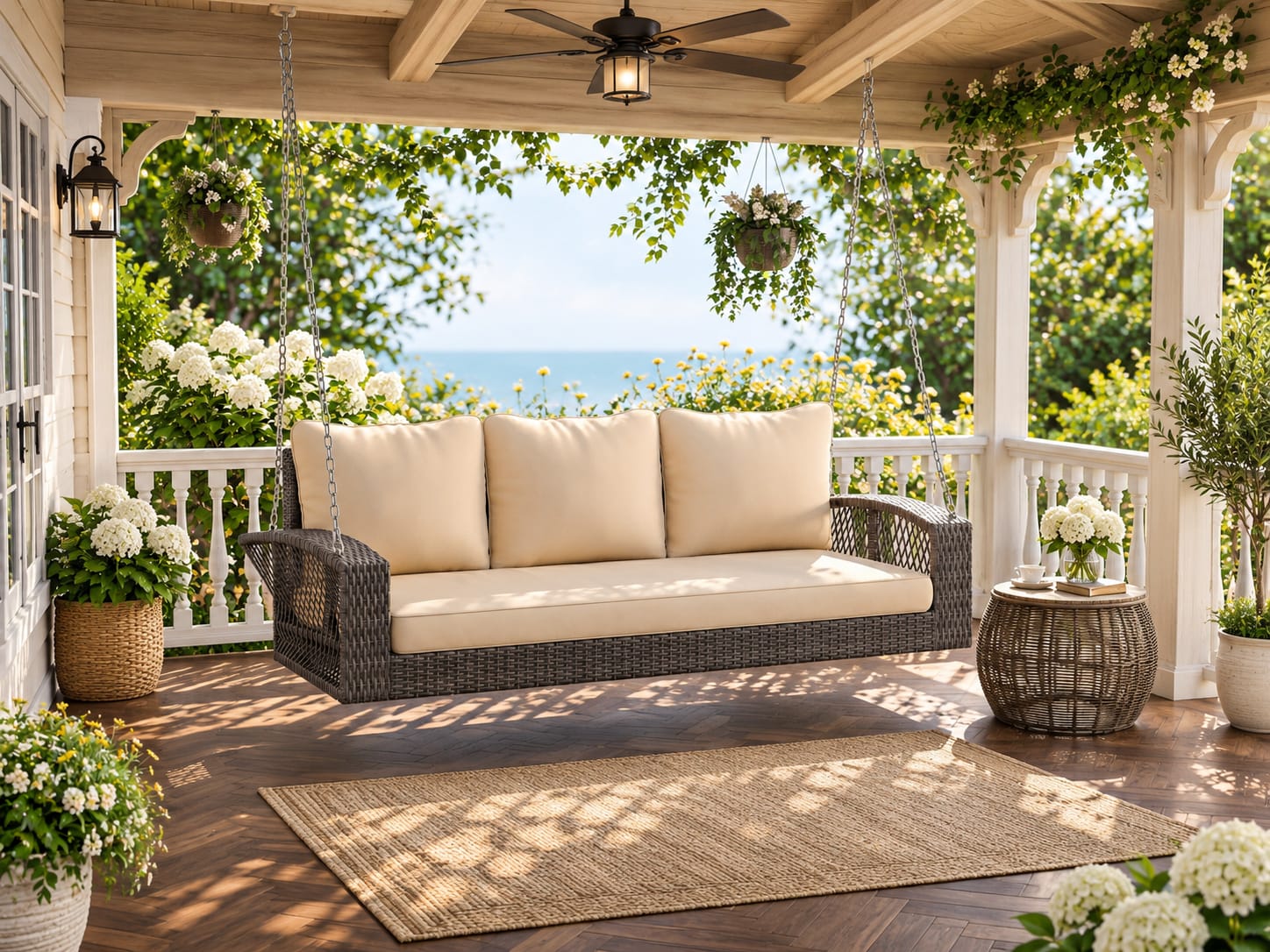
An outdoor wicker porch swing can make a covered porch or backyard seating area more inviting. Unlike a stationary bench, however, a hanging swing needs room to move and a supporting structure that can safely handle the load.
Before choosing a two-person or three-person swing, look beyond its advertised width. The usable seating area, front and back clearance, suspension system, and mounting location all affect whether it will work in your space.
This outdoor wicker porch swing size guide explains what to measure and check before buying, with real product dimensions to put the numbers into context.
Table of Contents
What Size Wicker Porch Swing Fits Your Porch?
Start with the number of people who will regularly use the swing and the amount of unobstructed space available.
| Swing type | Main measurement to check | Best consideration |
|---|---|---|
| Compact two-person swing | Overall width and usable seat width | Smaller covered porches |
| Roomier two-person swing | Seat width, depth, and side clearance | More personal seating space |
| Three-person wicker swing | Overall width, actual seat space, and load rating | Wider porches and shared seating |
| Swing with a freestanding stand | Complete stand footprint and movement clearance | Areas without suitable overhead support |
These are general categories, not standardized sizes. A product described as a three-person swing may have considerably less usable seat width than its advertised overall length.
A wide enough porch does not automatically mean a swing can be installed there. Structural support and movement clearance must be assessed separately.
Understanding Porch Swing Dimensions
Overall Width vs. Usable Seat Width
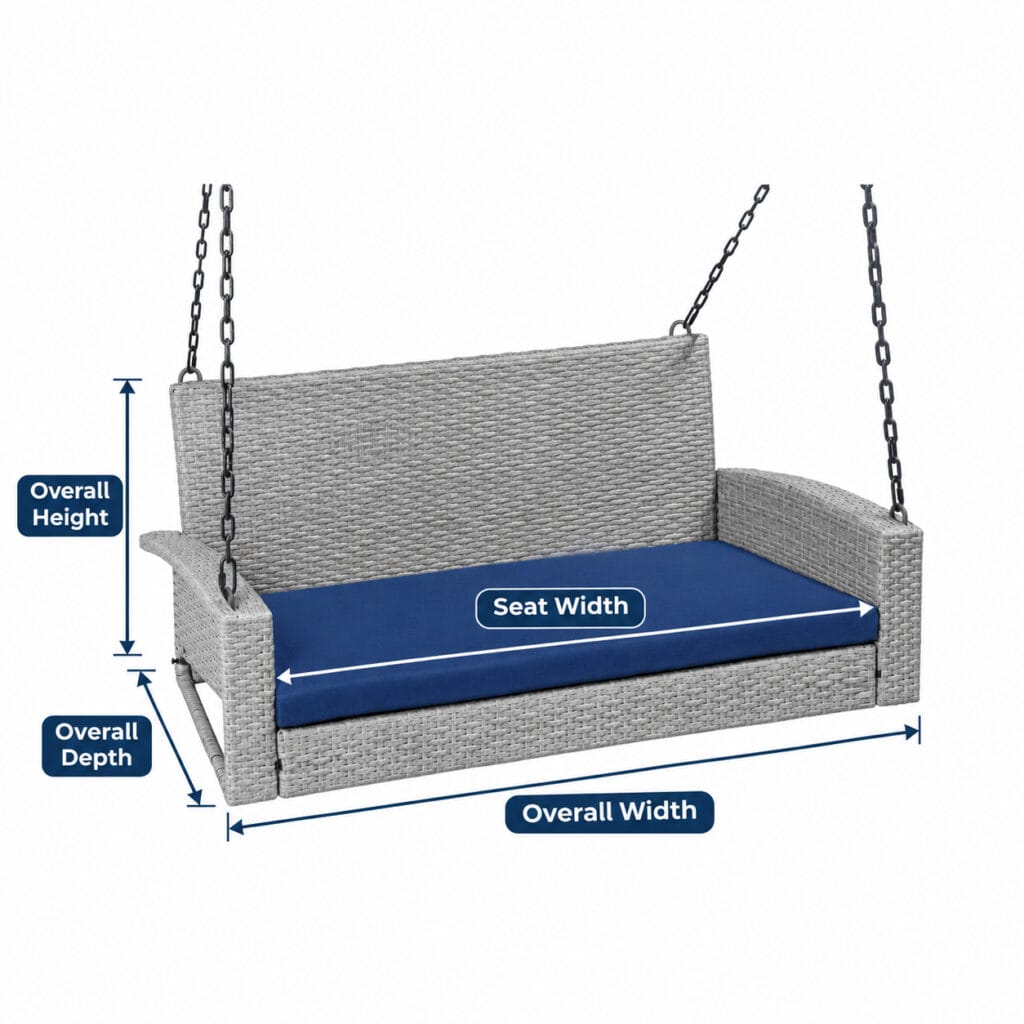
Overall width includes the outside edges of the swing, often including the arms and frame. Usable seat width is the actual space available for sitting.
For a real-world example, Threeman Products’ Classic Cedar Porch Swing measures 74 inches in overall width, but its usable seat length is 67 inches—a seven-inch difference. This wooden swing illustrates why advertised length and actual seating space should be checked separately; the difference isn’t a universal measurement for wicker models.
When comparing a two-person and three-person model, ask for the seat width if it isn’t listed.
Depth, Backrest Height, and Cushions
Overall depth describes the swing’s front-to-back measurement while stationary. Seat depth and backrest design influence comfort, while cushions may change the usable seating area.
Check whether product dimensions include the cushions and whether pillows or other accessories will extend beyond the frame.
Remember that stationary depth is not the full swinging clearance.
Hanging Height vs. Swing Height
A swing’s listed height is not the distance from the finished floor to the seat after installation.
The final seat height depends on the mounting position, suspension arrangement, and manufacturer’s instructions.
For its own porch swings, POLYWOOD provides a 17–19-inch seat-height recommendation. This is useful manufacturer guidance, not a universal installation requirement for other brands.
Never calculate a safe hanging position from the chain length alone.
How Much Clearance Does a Porch Swing Need?
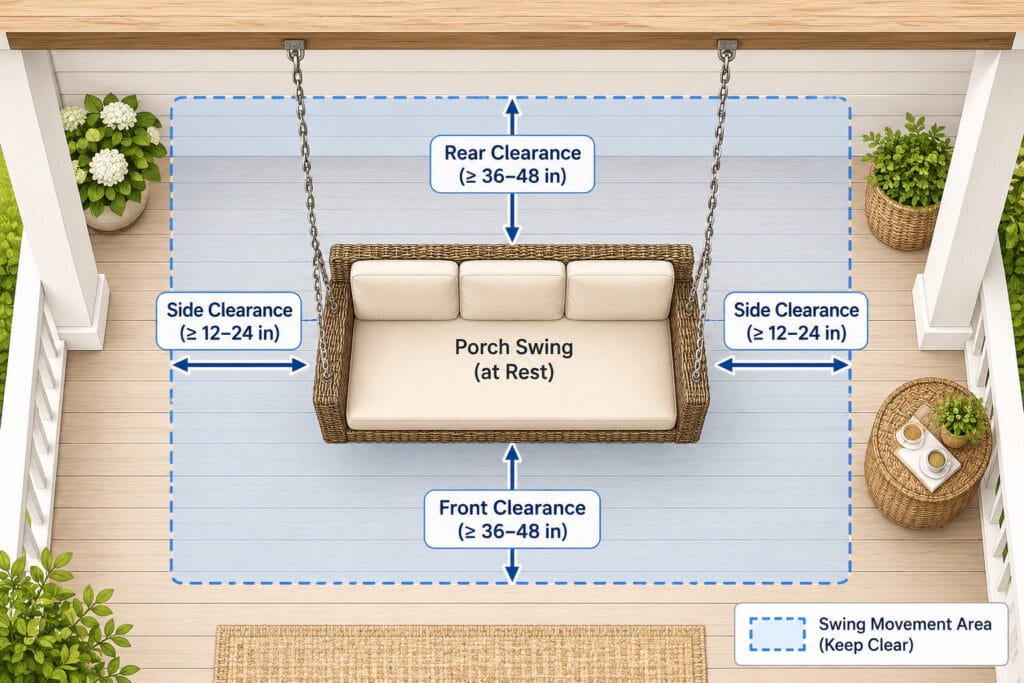
A porch swing moves beyond its resting footprint. Its full movement area should remain clear of walls, railings, furniture, planters, and frequently used walkways.
Front and Back Clearance
As one manufacturer-specific reference, POLYWOOD recommends 3–4 feet of clearance in front of and behind its porch swings.
That means considering space on both sides of the swing’s resting position—not treating 3–4 feet as the total combined movement area.
Other products may have different requirements. Always use the measurements and installation guidance for the chosen swing.
Side Clearance
POLYWOOD also recommends 12–14 inches of side clearance for its porch swings.
Check the nearest posts, walls, railings, and furniture, along with any suspension components that might interfere with the surrounding structure.
For a simple preliminary width calculation:
Required width = Overall swing width + Left-side clearance + Right-side clearance
For example, a 69-inch swing with 14 inches allowed on each side would require 97 inches, or approximately 8 feet 1 inch, of unobstructed width.
This is an illustrative planning calculation using another manufacturer’s clearance recommendation, not an approved installation dimension for the RattanKind 69-inch model.
Keep Swinging Space Separate From Walkways
A swing shouldn’t move across a doorway, porch steps, or a route people regularly use.
Check where people will walk when the swing is occupied, not only when it’s stationary.
If the available area cannot accommodate both the required movement space and normal access, a stationary outdoor bench may be more practical.
How to Measure Your Porch Before Buying
A few measurements can help reveal problems before ordering.
- Measure the clear porch width. Use the distance between actual obstacles, not just the outside dimensions of the porch.
- Identify the intended swing position. Check the available space in front, behind, and on both sides.
- Locate doors and circulation routes. Keep these separate from the swing’s movement area.
- Check the overhead structure. Establish whether suitable structural support exists before selecting an installation location.
- Confirm the manufacturer’s requirements. The final clearance and suspension arrangement must come from the chosen model’s instructions.
You can use painter’s tape to mark the proposed resting footprint and identify surrounding obstacles.
A tape outline is a layout aid—not a test of structural strength, safe swing travel, or installation suitability.
If you’re also arranging chairs and tables nearby, our Small Patio Furniture Size Guide covers general furniture measurements and circulation.
Hanging Hardware and Structural Support
Unlike a regular patio chair, a hanging swing transfers its load through chains or other suspension components into a supporting structure.
The swing’s advertised weight capacity does not establish the load capacity of your ceiling, beam, mounting hardware, or freestanding frame.
This Old House’s porch swing installation guide emphasizes using structural framing rather than relying on decorative ceiling surfaces.
Before installation, confirm:
- Structural capacity: The supporting structure is suitable for the intended suspended and moving loads.
- Mounting arrangement: Attachment locations and methods match the swing manufacturer’s instructions.
- Hardware compatibility: All connectors and suspension components are appropriate for the model.
- Complete system rating: The swing, hardware, and supporting structure have been evaluated together.
- Professional help: A qualified contractor or structural professional has assessed any uncertain framing or installation conditions.
Do not assume that an existing porch beam, decorative pergola, or tree branch is suitable simply because it appears substantial.
Avoid applying a generic safety-factor formula or substituting different chains, ropes, anchors, or fasteners without approved instructions.
Ceiling-Mounted vs. Freestanding Porch Swings
Both arrangements require adequate support and movement space, but their installation considerations differ.
| Feature | Ceiling-mounted swing | Freestanding swing frame |
|---|---|---|
| Support | Verified structural framing | Compatible manufacturer-rated stand |
| Space to measure | Swing clearance and suspension layout | Full stand footprint and swing clearance |
| Placement | Limited by suitable overhead structure | Depends on stand design and ground conditions |
| Main check | Structural support and mounting hardware | Stability, compatibility, and load rating |
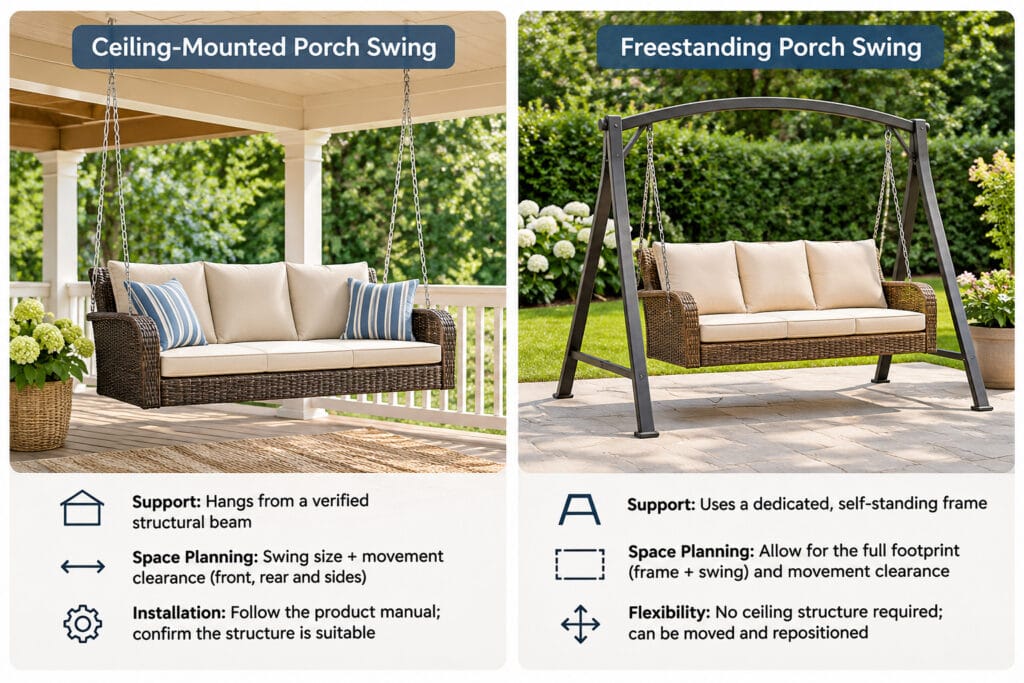
A freestanding frame may be useful where suitable overhead framing isn’t available. However, not all hanging wicker swings are approved for every aftermarket stand.
Confirm compatibility with both manufacturers before combining components.
Comfort, Materials, and Outdoor Care
A longer swing can accommodate more people, but usable seat width, seat depth, back support, and cushion design matter more than the advertised seating count alone.
For outdoor wicker designs, also review the construction:
| Component | What to check |
|---|---|
| PE rattan wicker | Manufacturer’s outdoor-use and care guidance |
| Metal frame | Protective finish, joints, and corrosion |
| Hanging chains and connectors | Wear, corrosion, damage, and approved replacement parts |
| Seat and back cushions | Fabric care, drying, and storage recommendations |
PE rattan is often better suited to outdoor exposure than natural rattan, but the wicker is only one part of the furniture.
For more information, see our PE Rattan vs. Natural Rattan Guide.
Inspect suspension components as directed by the manufacturer, and stop using the swing if you notice damage, loose connections, or unusual movement until it has been properly assessed.
Real Product Example: RattanKind’s 69-Inch Wicker Porch Swing
The RattanKind 69-Inch 3-Person Wicker Porch Swing provides a useful example of how product specifications differ from installation requirements.
| Specification | Product-listed information |
|---|---|
| Overall dimensions | 69″ L × 22.4″ D × 19.9″ H |
| Advertised seating | Up to three people |
| Maximum weight capacity | 800 lbs |
| Net weight | 44.09 lbs |
| Included chains | Two, each listed at 102.4″ |
| Frame | Powder-coated iron |
| Wicker | PE synthetic wicker |
| Cushions | Polyester fabric and foam |
| Assembly | Required |
Specifications come from the product listing and are not independent structural test results. Confirm the current listing and official installation instructions before purchasing or installing.
What These Numbers Tell You
The 69-inch overall length helps you assess available width, but doesn’t tell you the actual usable seat width.
The listed 22.4-inch depth describes the furniture itself—not the full clearance required while swinging.
The 800-pound rating is the product’s advertised maximum capacity. It does not certify that a particular porch structure or mounting system can support that load.
And the included chain length does not determine the correct ceiling height, attachment layout, or seat height for your installation.
These distinctions apply equally to smaller two-person models and larger wicker porch swings.
Porch Swing Pre-Purchase Checklist
Before ordering, verify the following:
- Does the swing’s overall width fit with the manufacturer’s required side clearance?
- Is there enough front and back space for the full movement area?
- Will the swing remain clear of doors, steps, and primary walkways?
- Has the intended supporting structure been assessed?
- Are the suspension components and mounting method approved for the model?
- Are the usable seating dimensions and weight limits appropriate?
- Can the wicker, cushions, frame, and hardware be maintained in your climate?
If critical structural or installation details are missing, obtain the official instructions or consult a qualified professional before proceeding.
Frequently Asked Questions
How wide does a porch need to be for a wicker swing?
Add the swing’s overall width to the left and right clearances required by its manufacturer. Also confirm that the swing has a suitable mounting location and doesn’t interfere with doors or walkways.
How much space should I leave in front of and behind a porch swing?
It depends on the model. POLYWOOD, for example, recommends 3–4 feet in each direction for its porch swings. Use the instructions supplied with your swing for the final layout.
Can I hang a three-person wicker swing from a pergola?
Only if the pergola is structurally suitable for the intended swing loads and the suspension system is compatible. A decorative pergola should not be assumed safe for hanging furniture.
Does a porch swing come with all the mounting hardware?
Not always. Chains and assembly hardware may be included while structural mounting components are supplied separately. Check the package contents and manual before ordering.
Is synthetic wicker suitable for outdoor porch swings?
PE wicker is common in outdoor furniture, but durability also depends on the frame, cushions, hanging hardware, and care instructions. Inspect the complete swing and protect removable cushions as recommended.
Final Thoughts: Measure More Than the Swing
Choosing the right wicker porch swing involves more than finding a bench that fits between porch posts.
Check the actual seating space, front and back movement clearance, suspension requirements, and supporting structure before deciding.
For a real three-person example, see the RattanKind 69-Inch Wicker Porch Swing and review its specifications and installation instructions before planning the final hanging location.