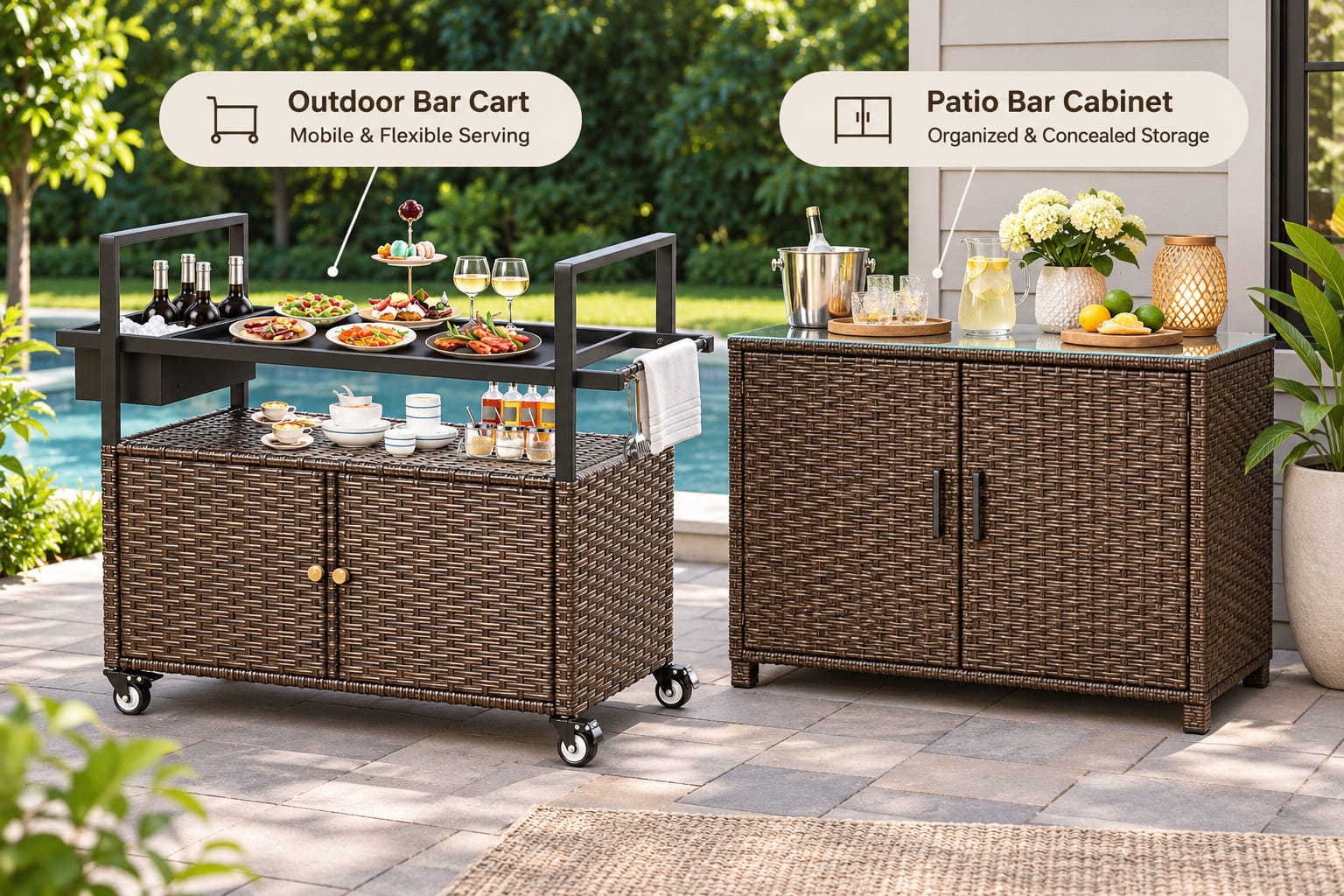
An outdoor wicker bar cart lets you bring drinks, snacks, and serving essentials closer to your guests. A patio bar cabinet, meanwhile, is better suited to keeping supplies organized in one dedicated area.
But the distinction isn’t always clear. Some rattan bar carts include drawers and enclosed cabinets, while certain cabinet-style serving stations have wheels.
The better question is: Do you need to move your serving furniture, keep supplies out of sight, or do both?
This guide compares bar carts, cabinets, and hybrid designs, with practical advice on storage, patio measurements, materials, and everyday use.
Table of Contents
Quick Comparison: Outdoor Bar Cart vs. Bar Cabinet
Start with two questions: How often will you move the furniture, and what do you need to store?
| Feature | Outdoor Bar Cart | Patio Bar Cabinet |
|---|---|---|
| Main purpose | Flexible serving | Organized, dedicated storage |
| Mobility | Usually wheeled | Often stationary; some have casters |
| Storage | Open shelves, drawers, or small cabinets | More emphasis on enclosed compartments |
| Serving surface | Compact to generous, depending on model | Often designed as a consistent serving station |
| Space to check | Rolling route and turning room | Door, drawer, and standing access |
| Best fit | Multipurpose patios and changing seating layouts | Established outdoor entertaining areas |
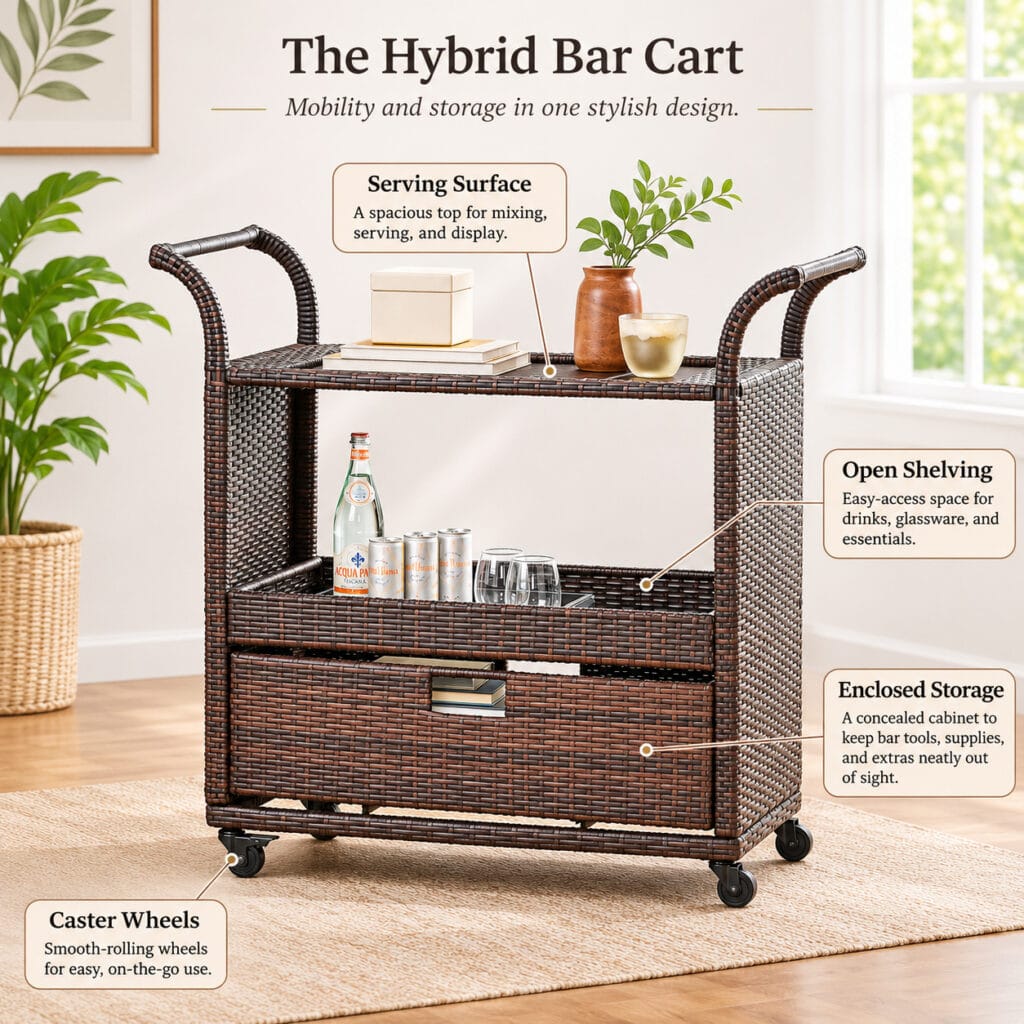
A hybrid bar cart with a built-in cabinet combines mobility with concealed storage. For many patios, this is worth considering alongside the two traditional categories.
No design is automatically smaller or better. A compact cabinet can occupy less floor space than a large rolling cart.
When Is an Outdoor Wicker Bar Cart the Better Choice?
Choose a bar cart when your patio serves several purposes and you want to reposition serving supplies.
Flexible Serving for Gatherings
A rolling cart can carry drinks, cups, plates, and napkins between a dining table and a lounge area without requiring a separate serving station in each location.
Before buying, think about what you’ll actually place on top. A pitcher and a tray need different amounts of space than a full collection of glasses and serving accessories.
Food & Wine’s outdoor bar cart buying guide also highlights practical features such as shelves, glass storage, and room for an ice bucket.
Look for a usable tabletop, secure lower storage, and convenient access to the items you’ll reach for most often.
Wheels Don’t Guarantee Easy Movement
A cart with wheels may work well on a smooth concrete patio but be less convenient on uneven pavers or a deck with wide board gaps.
Before choosing a rolling model, check:
- Wheel design: Are the casters suitable for your outdoor surface?
- Wheel locks: Can the cart be kept stationary during serving?
- Loaded weight: Will it remain manageable with bottles and dishes inside?
- Handles: Do they make the cart easier to steer or increase its overall width?
- Steps and thresholds: Does your route require lifting the cart?
A four-wheel cart can usually roll without one end being lifted. Some two-wheel trolley designs require the user to raise one side before moving them. The construction matters more than the product name.
For an irregular stone patio or a route involving steps, a dedicated serving spot may be more practical than moving a fully loaded cart.
Open Shelves or Hidden Storage?
Open shelves keep frequently used supplies visible and accessible. Drawers are useful for bottle openers, coasters, and smaller accessories.
A cabinet-equipped cart can hide larger items, but a closed door does not make the compartment waterproof, dustproof, or pestproof.
Avoid leaving moisture-sensitive tableware, linens, or food inside unless the product’s storage conditions are suitable.
When Does a Patio Bar Cabinet Make More Sense?
A cabinet-style unit makes sense when you prefer a consistent serving location and have supplies you want to keep organized between gatherings.
More Room for Concealed Organization
A double-door cabinet can help keep trays, utensils, and serving accessories out of sight.
However, exterior size doesn’t tell you what fits inside. Check the clear interior width, shelf height, and door opening before buying.
A tall pitcher may not fit beneath a fixed shelf, and a wide serving tray may be difficult to remove through a narrow cabinet opening.
A Dedicated Serving Area
A bar cabinet can sit along a patio wall or beside an outdoor dining area, where its top becomes a regular place to arrange drinks and snacks.
If you rarely rearrange furniture, the convenience of concealed storage may matter more than wheels.
A cabinet can also have casters. In that case, treat it as a hybrid model and evaluate both mobility and storage access.
When Is a Hybrid Bar Cart the Better Choice?
A hybrid wicker bar cart combines features that would otherwise require separate furniture: a serving top, open shelf, enclosed cabinet, and wheels.
It can be a good fit when you want everyday storage but occasionally move supplies closer to guests.
The trade-off is size and weight. A larger hybrid cart may be harder to maneuver than a simple two-tier cart, especially when loaded.
Compare the available models by their actual dimensions and layout, not simply by whether the seller calls them a bar cart, buffet cabinet, or outdoor kitchen island.
How Much Patio Space Do You Need?
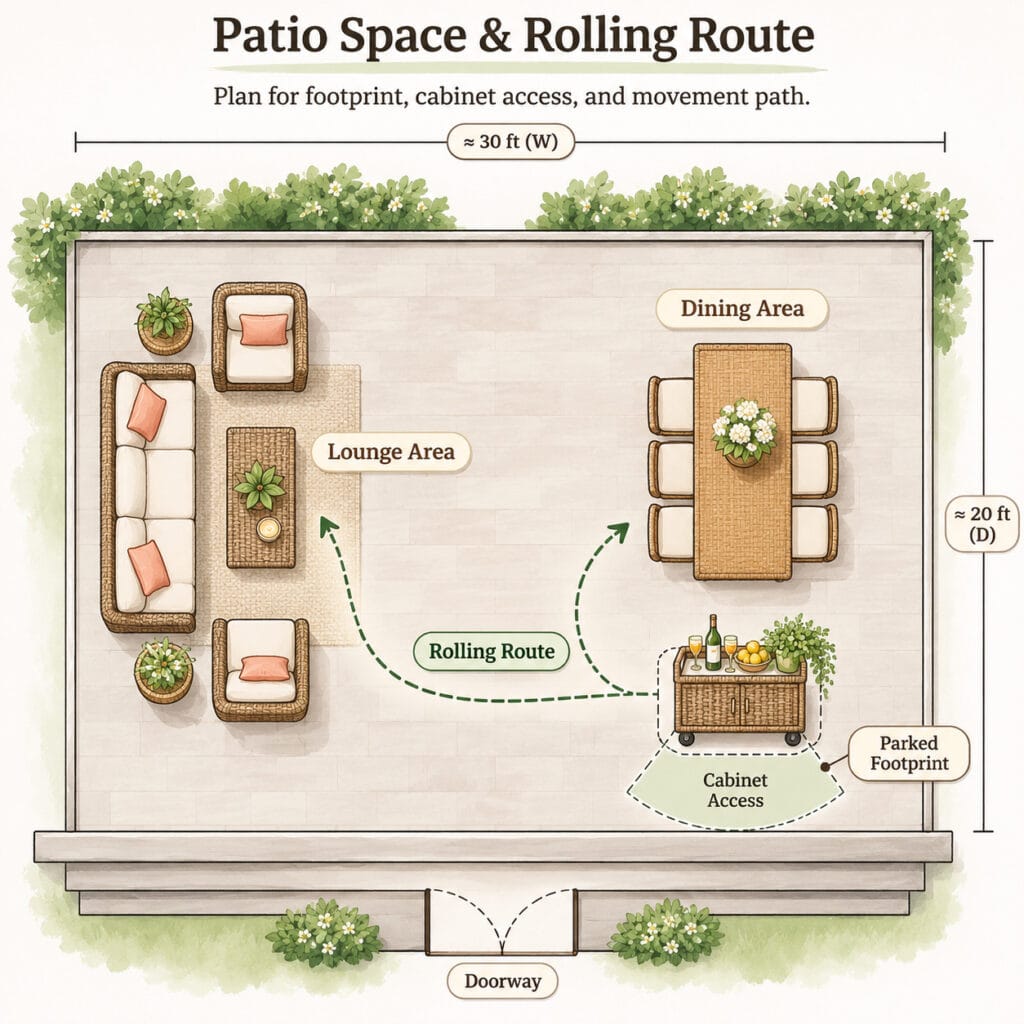
The right size depends on more than the furniture’s parking spot. You also need room to access drawers, open cabinet doors, and move a cart along its intended route.
Calculate the Footprint
Measure the overall width and depth, including protruding handles.
Footprint (sq. ft.) = Width (in.) × Depth (in.) ÷ 144
For example, a 39.4-inch-wide × 21.7-inch-deep unit occupies approximately 5.9 square feet.
That is only the furniture’s footprint. It doesn’t include door clearance, people standing nearby, or cart movement.
Check Cabinet and Drawer Access
A cabinet needs clear space in front of its doors. A drawer requires enough room to extend fully without hitting another chair or table.
There is no universal 24-inch door-clearance rule for all outdoor cabinets. The required distance depends on the actual door or drawer design and how someone will access it.
If the cabinet will be placed near a dining set, check whether someone can open it while chairs are occupied.
Measure the Entire Rolling Route
For a wheeled cart, measure from its usual storage position to the areas where you’ll serve guests.
Include the narrowest doorway or gate, tight corners, deck board gaps, and any changes in floor level.
As an accessibility reference, the U.S. Access Board’s ADA Standards, Section 403.5.1, generally require at least 36 inches of clear width on covered accessible walking routes, with limited exceptions.
This is not a universal legal requirement for a private residential patio, nor does a 36-inch-wide path guarantee that a particular cart can turn through it. Use it as context for why keeping a comfortable walking route matters.
Try a Simple Patio Fit Test
Before ordering:
- Mark the furniture’s footprint using painter’s tape.
- Measure the narrowest part of the proposed rolling route.
- Check handles, doors, drawers, and nearby chairs.
- Walk the route and imagine steering the cart around each turn.
- Consider whether guests can still move comfortably when the serving area is in use.
If the cart would be difficult to move without disturbing furniture, keeping it in one dedicated location may be the better plan.
Materials, Tabletops, and Outdoor Exposure
Outdoor wicker furniture commonly uses PE rattan, also known as synthetic or resin wicker. It offers a woven appearance while generally being more suitable for outdoor exposure than natural rattan.
Still, the frame, tabletop, and hardware matter just as much as the wicker.
| Component | What to check |
|---|---|
| PE rattan wicker | Weave quality and manufacturer care instructions |
| Steel or iron frame | Protective coating and corrosion resistance |
| Aluminum frame | Construction, joints, and load rating |
| Tempered-glass top | Secure attachment and care requirements |
| Composite tabletop | Moisture, heat, and cleaning limitations |
| Wheels and hinges | Brakes, fasteners, and smooth operation |
Weather-resistant wicker doesn’t mean the whole cabinet is watertight. Dry wet accessories before storing them, and follow the manufacturer’s guidance during heavy rain and winter weather.
For a more detailed material comparison, see our PE Rattan vs. Natural Rattan Guide.
Can You Put a Wicker Bar Cart Near a Grill?
It may be useful as a serving station for plates, condiments, and utensils, but keep it away from open flames and intense heat.
Follow the grill manufacturer’s specified clearances. Don’t place hot cookware, grills, or fuel containers on or inside the cart unless the product is explicitly designed and rated for that purpose.
Compare RattanKind Outdoor Wicker Bar Furniture
RattanKind has several serving and storage designs that illustrate how the categories overlap.
| Product | Main features | Overall dimensions |
|---|---|---|
| Rattan Bar Cart with Glass Top & Drawer | Wheeled serving cart, glass top, drawer | Check product page |
| Outdoor Wicker Bar Cart with Storage Cabinet | Wheeled cart, open shelf, double-door cabinet | 39.4″ W × 21.7″ D × 34.6″ H |
| Rattan Outdoor Storage Cart with Wheels & Glass Top | Glass serving top, middle shelf, lower cabinet, lockable wheels | 51.2″ W × 19.7″ D × 35.4″ H |
Specifications are based on product listings, not independent performance tests. Confirm current dimensions, features, and availability before ordering.
For a serving cart with a glass top and drawer, see the Rattan Bar Cart with Glass Top & Drawer.
If you want both open and concealed storage, explore the Outdoor Wicker Bar Cart with Storage Cabinet.
For a larger mobile serving and storage setup, compare the Rattan Outdoor Storage Cart with Wheels & Glass Top.
These are examples of mobile and hybrid designs—not a controlled comparison with a stationary cabinet. As additional styles become available, the same feature and measurement checks can help you compare them.
Outdoor Bar Furniture Buying Checklist
Before choosing a model, ask:
- Will I move it regularly? Check wheel design, locks, total weight, and the route.
- What will I store? Measure your tallest bottles, widest trays, and frequently used supplies.
- Is the countertop large enough? Allow space for actual serving items.
- Will cabinet doors open comfortably? Check surrounding chairs and pathways.
- Where will it stay between gatherings? Consider weather exposure and seasonal storage.
- Are the materials appropriate? Review frame, tabletop, hardware, load limits, and care instructions.
Frequently Asked Questions
Is a wicker bar cart good for a small patio?
It can be, especially when you need flexible serving space. Choose based on the cart’s actual footprint, storage needs, and whether it can move through your patio without blocking the main walkway.
Do outdoor bar carts need locking wheels?
Not always, but locks can be useful when the cart is parked for serving. They are not a substitute for a stable, suitable surface, particularly on a slope.
Can a patio bar cabinet stay outside all year?
That depends on its materials, construction, and care instructions. Outdoor-rated wicker may tolerate weather exposure, but enclosed storage, tabletops, and metal hardware can still require protection.
Is a wheeled bar cabinet better than a separate cart and storage cabinet?
It may be more convenient if you want serving space and concealed storage in one piece. However, a larger hybrid cart may be heavier or harder to maneuver than separate, smaller furniture.
Final Thoughts: Choose for Your Entertaining Style
Choose an outdoor wicker bar cart when mobility and flexible serving matter most. A patio bar cabinet makes sense when you want concealed storage in a dedicated location.
If both needs are important, a hybrid wheeled cabinet may offer the right balance.
Before buying, compare the real footprint, storage dimensions, wheel design, and access space—not just the furniture’s name or appearance. The best choice is one that makes your patio easier to use, whether you’re hosting a group or enjoying a quiet evening outdoors.