If you’re shopping for patio furniture, terms like PE rattan, resin wicker, HDPE wicker, or all-weather wicker might feel confusing. Many homeowners ask: Is PE rattan toxic? Especially for outdoor use where furniture is exposed to sun, rain, and pets or children.
This guide provides a U.S.-focused, authoritative overview of PE rattan, its safety, mold resistance, outdoor durability, and buying considerations.
Table of Contents
1. What Is PE Rattan?
Polyethylene (PE) rattan is a synthetic fiber made from high-density polyethylene (HDPE). It is extruded into flexible strips, then hand- or machine-woven over powder-coated aluminum frames, mimicking natural wicker.
Alternative terms in the U.S.:
| Term | Notes |
|---|---|
| PE Wicker | Common U.S. term |
| Resin Wicker | Emphasizes resin base |
| Synthetic Rattan | Generic term for artificial wicker |
| All-Weather Wicker | Highlights outdoor durability |
| HDPE Wicker | High-density polyethylene |
Why it matters:
Unlike natural rattan, PE rattan does not absorb water and is impervious to outdoor moisture. The powder-coated aluminum frame ensures lightweight, rust-proof stability.
2. Is PE Rattan Toxic? (FDA & Safety Standards)
Short answer: ✅ No.
- Material safety: HDPE/PE is FDA-approved for food contact, widely used in Tupperware, water bottles, children’s toys, and medical equipment.
- Chemicals: High-quality PE rattan is free of BPA, phthalates, and formaldehyde.
- CPSC & ANSI: Complies with CPSC 16 CFR 1303 (flammability, heavy metals) and ANSI/BIFMA X5.4 (outdoor furniture safety).
UV Exposure: ASTM D4329 tests show premium PE rattan withstands 3000+ hours of accelerated UV exposure with minimal degradation. Normal outdoor temperatures (even in AZ or TX) do not reach the decomposition threshold (~302°F / 150°C).
Tip: Look for “UV-stabilized” or “outdoor-grade” PE rattan.
3. Is PE Rattan Safe for Children & Pets?
Yes. It is widely recognized as child and pet-friendly:
| Safety Feature | Explanation |
|---|---|
| Smooth surface | No splinters or sharp edges |
| Non-toxic | Compliant with FDA, CPSC safety |
| Easy to clean | Food spills, pet hair, dirt → just use mild soap + water |
| Durable | PE rattan + powder-coated aluminum can withstand outdoor use and active play |
4. Does PE Rattan Mold?
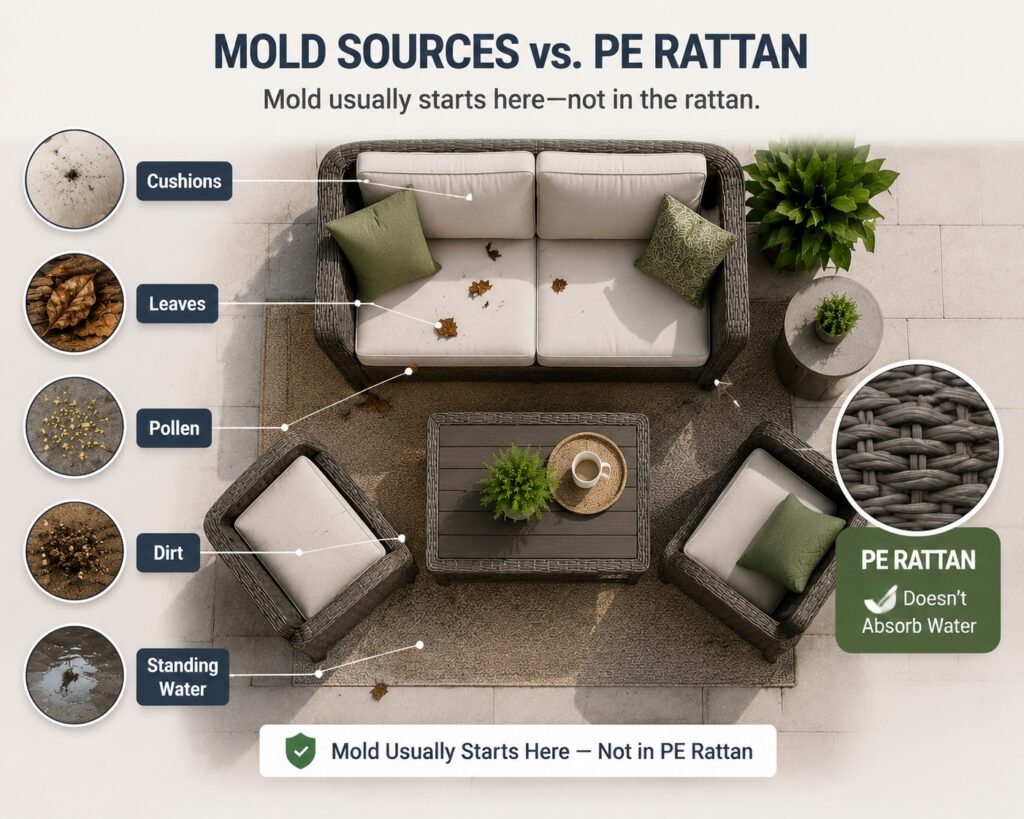
Key point: PE rattan itself doesn’t mold.
- Mold needs water + organic material + temperature. PE is non-porous, no organic matter → no mold.
- Most outdoor mold issues come from:
- Cushions / fabrics
- Fallen leaves / pollen
- Dirt trapped in weave
- Improper drainage
For homeowners in Florida, Georgia, Louisiana, and other humid climates, PE rattan is often the most practical outdoor furniture material thanks to its moisture resistance and low-maintenance design. If you’re comparing furniture options for wet or coastal environments, read Best Rattan Patio Furniture for Rainy or Humid Climates to learn which materials, frame types, and cushion fabrics hold up best outdoors.
5. PE Rattan vs. Natural Rattan (Humidity & Weather)
| Feature | PE Rattan | Natural Rattan |
|---|---|---|
| Water resistance | ★★★★★ | ★☆☆☆☆ |
| Mold resistance | ★★★★★ | ★★☆☆☆ |
| UV stability | ★★★★☆ | ★★☆☆☆ |
| Outdoor lifespan | 5–15+ years | 1–2 years |
| Maintenance | Low (washable) | High (requires oil/varnish) |
Tip: For Florida, Gulf Coast, Louisiana, PE rattan is strongly recommended.
While natural rattan offers a traditional handcrafted look, PE rattan is specifically engineered for outdoor use. For a deeper comparison of durability, maintenance, and weather resistance, see PE Rattan vs. Natural Rattan: Which Is Better for Outdoor Furniture?
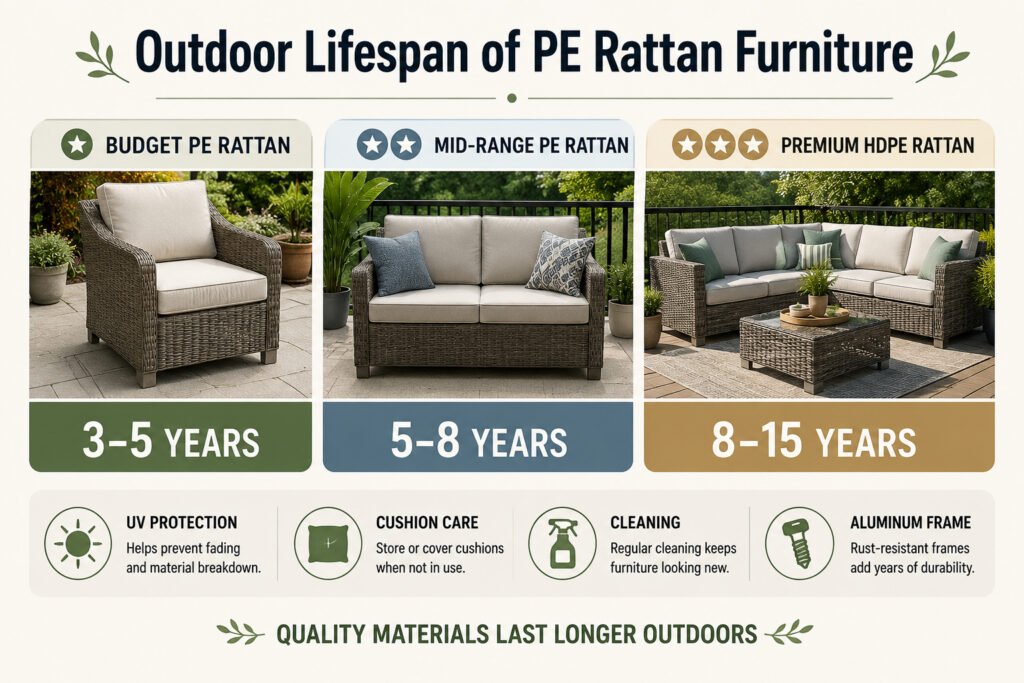
6. Lifespan & Durability
| PE Rattan Grade | Frame | UV Protection | Typical Outdoor Lifespan |
|---|---|---|---|
| Budget | Steel / basic PE | Minimal | 3–5 years |
| Mid-range | Powder-coated aluminum + PE | Standard | 5–8 years |
| Premium HDPE | Aluminum + thick weave + UV stabilizers | Full | 8–15 years |
Factors affecting lifespan:
- UV stabilization
- Frame material (aluminum > steel)
- Cushion storage
- Regular cleaning
7. How to Choose High-Quality PE Rattan
Checklist for purchase:
✅ UV-stabilized PE / HDPE
✅ Powder-coated aluminum frame
✅ Weather-resistant cushions (Sunbrella / Olefin)
✅ Tight, even weave
✅ Warranty / SGS / Intertek certification
❌ Avoid:
- PVC wicker sold as PE
- Bare steel / untreated metal
- Sparse weave or overly thin PE
- Low-quality recycled plastic
If you’re shopping for outdoor furniture that combines durability, low maintenance, and all-weather performance, browse our Rattan Patio Furniture Sets collection to see PE rattan designs built for year-round outdoor use.
8. Common Misconceptions
| Misconception | Truth |
|---|---|
| All plastic outdoor furniture is toxic | High-quality PE rattan is FDA-approved and non-toxic |
| PE rattan molds easily | Only cushions or debris mold; PE itself resists mold |
| Natural rattan is better outdoors | PE rattan outperforms in durability, maintenance, and weather-resistance |
| PE rattan heats up dangerously | Airy weave + cushions mitigate heat; avoid dark furniture under direct summer sun |
9. FAQ
Is PE rattan toxic when heated?
No, normal outdoor heat won’t release harmful chemicals.
Is PE rattan BPA-free?
Yes, FDA-approved HDPE is BPA-free.
Can mold grow on PE rattan?
Only on debris or cushions, not on the PE itself.
Is PE rattan safe for pets?
Yes, smooth surface and non-toxic.
Does PE rattan crack in the sun?
High-quality UV-stabilized PE resists cracking.
How long does PE rattan last outdoors?
5–15 years depending on quality.
Is HDPE better than PE rattan?
HDPE is higher density and more durable than standard PE.
10. Conclusion
PE rattan is a safe, mold-resistant, and highly durable choice for U.S. outdoor furniture.
- ✅ Safe for families, pets, and food
- ✅ Non-toxic, BPA-free, phthalate-free, FDA-compliant
- ✅ Resists mold, UV, and harsh weather
- ✅ Lasts 5–15 years depending on grade
- ✅ Opt for certified UV-stabilized HDPE with aluminum frame