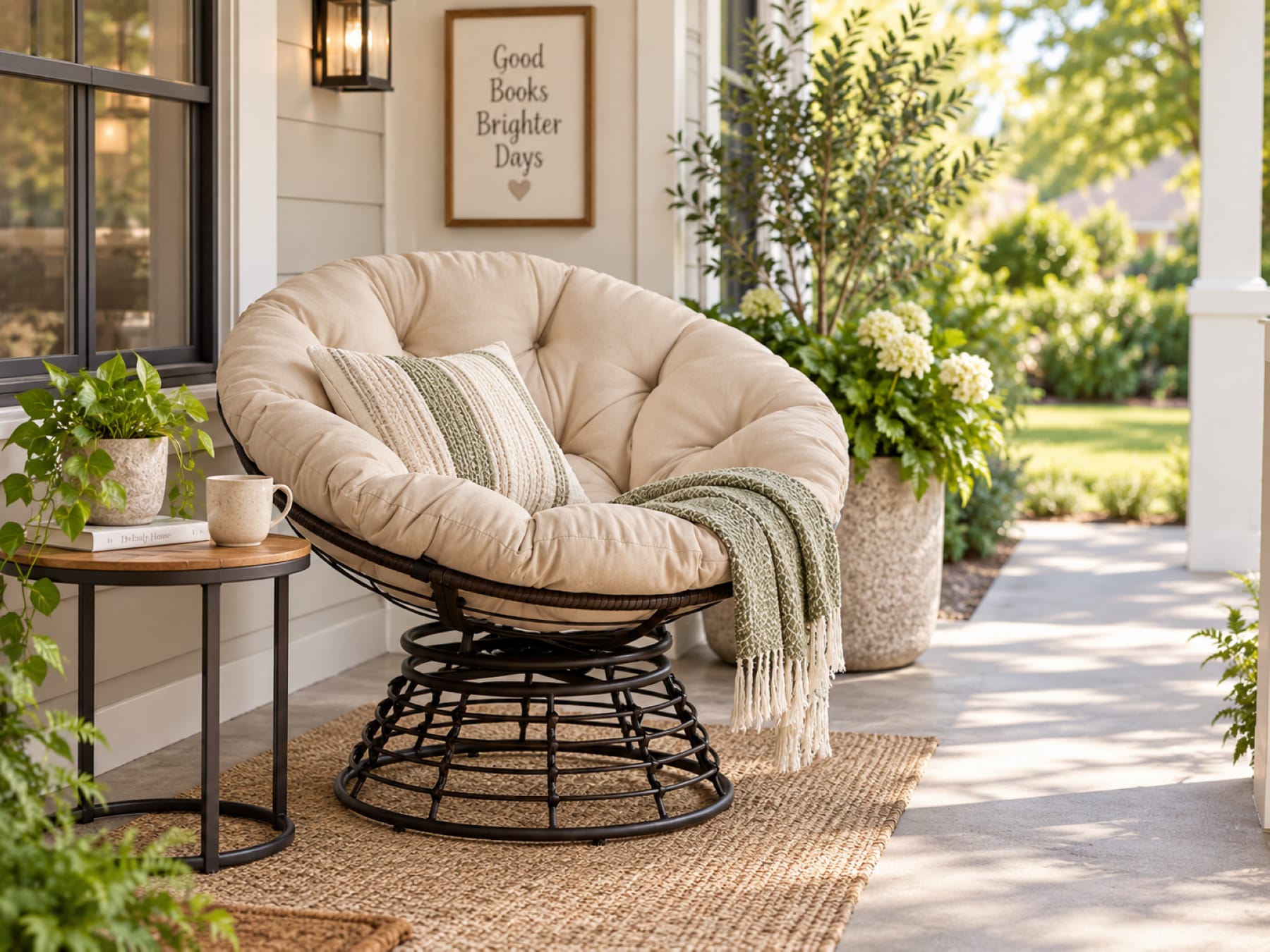
An outdoor papasan chair can turn an unused patio corner into a comfortable place to read, drink coffee, or unwind. But on a small patio or balcony, the chair has to do more than look good.
The real question is whether it fits when you actually use it.
Papasan chairs have wide, rounded seats that often extend well beyond the base. Swivel versions need even more planning because the upper frame moves as the chair turns. A setup that looks fine in a product photo can feel cramped once the chair, side table, railing, and patio door all compete for the same few feet of space.
For small patios, apartment balconies, covered porches, and compact backyard areas, focus on four things:
- the chair’s full outside width and depth;
- the space needed for swivel movement;
- the main walking route;
- and the furniture you place beside it.
This guide explains how to measure a papasan chair, where to place it, how much clearance to leave, and which layouts work best in small outdoor spaces.
Table of Contents
Quick Answer: How Much Space Does an Outdoor Papasan Chair Need?
Start with the chair’s full outside dimensions, not the size of the base.
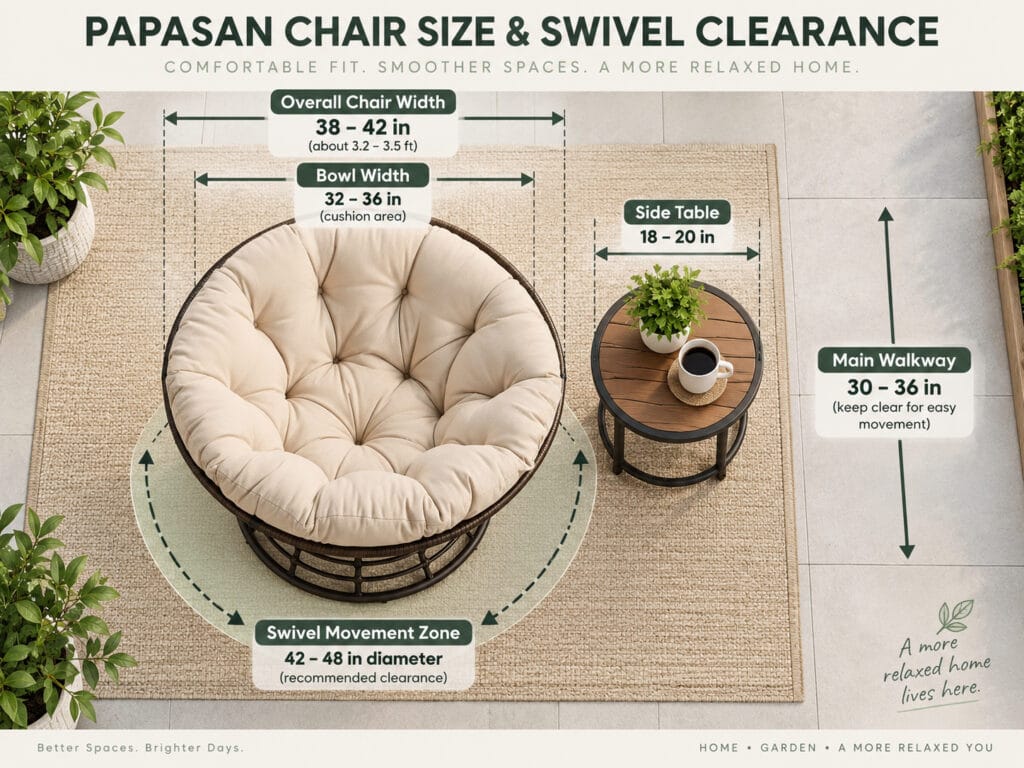
A useful planning range for many compact outdoor papasan chairs is:
| Planning Detail | Practical Starting Range |
|---|---|
| Overall chair width | About 36–45 in |
| Overall chair depth | About 34–42 in |
| Extra swivel space | Several inches on the moving sides |
| Side table size | About 16–22 in |
| Primary walking route | About 30–36 in when space allows |
| Wall or railing clearance | Enough to prevent contact while rotating |
These are planning ranges, not universal papasan-chair dimensions.
The actual footprint can change significantly depending on:
- bowl size;
- base design;
- cushion thickness;
- seat angle;
- swivel mechanism;
- and whether the chair reclines or rocks.
For a fixed papasan chair, the published overall dimensions may be enough for basic layout planning.
For a swivel papasan chair, also consider the space used while the seat is turning.
Why Papasan Chairs Work Well in Small Outdoor Spaces
A papasan chair creates a very different visual effect from a standard patio lounge chair.
Instead of a boxy rectangular frame, it uses a rounded or bowl-shaped seat. That softer outline can work especially well in:
- apartment patios;
- small balconies;
- covered porches;
- unused patio corners;
- reading nooks;
- and compact conversation areas.
One chair can define an entire lounge zone without requiring a loveseat or full conversation set.
That makes a papasan especially useful when your main goal is one comfortable place to:
- read;
- drink coffee;
- use a tablet;
- enjoy the view;
- or relax outdoors.
The trade-off is width.
A rounded chair may look visually compact, but the outside edges of the bowl can extend much farther than a slim dining chair or upright accent chair.
For small spaces, the full chair footprint matters more than the number of furniture pieces.
Measure the Full Papasan Footprint Before You Buy
One of the easiest mistakes is measuring only the base.
A papasan may have a relatively compact pedestal or lower frame while the upper bowl extends several inches farther in every direction.
That means the base can fit between a wall and a side table while the seat above it still hits:
- a railing;
- wall;
- planter;
- door frame;
- or another chair.
Before ordering, check the chair at its widest point.
What to Measure on the Product Page
Look for:
- overall width;
- overall depth;
- maximum bowl width;
- base width or diameter;
- seat height;
- swivel function;
- cushion thickness.
If the product page does not list every dimension, use the full overall width and depth as your minimum planning footprint rather than estimating from the base.
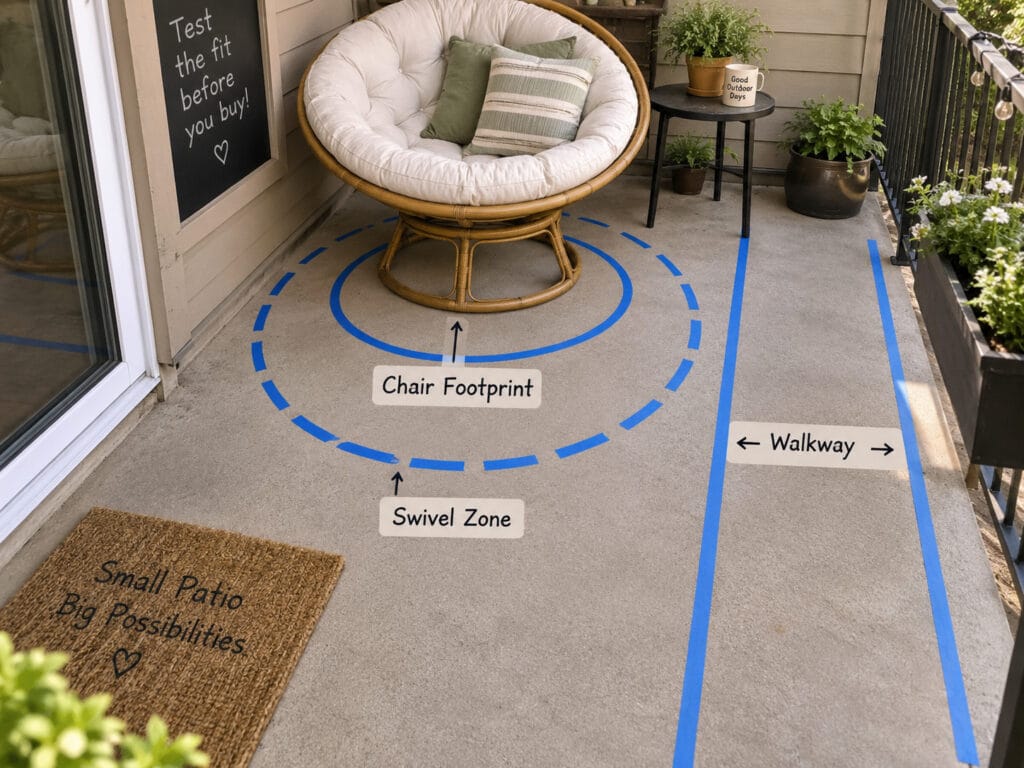
Use Painter’s Tape
Before ordering, mark the chair’s full footprint on the patio floor with painter’s tape.
If the chair is 40 inches wide, mark the full 40-inch area—not just the smaller base.
Then mark:
- the side table;
- the main walkway;
- the patio door;
- and any railing, wall, or fixed planter nearby.
For a swivel chair, add a little extra room around the sides that move.
Then physically walk through the layout.
Ask:
- Can the patio door still open normally?
- Can I get around the chair without turning sideways?
- Will the chair hit the railing when it rotates?
- Can I reach the side table comfortably?
- Is there still enough room to sit down and stand up?
On a small balcony, a few inches can change the entire layout.
How Much Swivel Clearance Does a Papasan Chair Need?
Swivel clearance is one of the biggest differences between a papasan chair and a fixed patio chair.
A stationary chair needs room for:
- the chair itself;
- sitting down;
- standing up.
A swivel papasan also needs room for the upper seat to move.
You do not necessarily need a large empty circle around the entire chair. What matters is keeping the moving sides away from obstacles.
Avoid placing the seat edge directly against:
- a wall;
- balcony railing;
- glass door;
- planter;
- side table;
- grill;
- or another chair.
A good practical approach is to leave several inches of free space and then physically test the rotation before you settle on the layout.
Don’t Push It Tight Into a Corner
A corner is often the best place for a papasan—but that does not mean the chair should be pressed all the way back against both walls.
Pull it slightly forward.
That gives the bowl more room to rotate and usually makes the chair look less crowded.
A chair can appear perfectly positioned while facing straight ahead and then hit the wall after turning only 30 or 45 degrees.
Always test the chair in more than one position.
Best Places to Put an Outdoor Papasan Chair
1. In a Patio Corner
A corner is one of the easiest places to make a papasan work.
The curved chair softens a square patio corner and creates a clear lounge zone without requiring several pieces of furniture.
A simple setup can include:
- one papasan chair;
- one 16–20 inch side table;
- one small planter;
- an optional outdoor rug.
Keep the main walkway on the opposite side whenever possible.
This layout works especially well if the patio door opens away from the chair.
Best for:
- reading;
- morning coffee;
- solo lounging;
- small patios;
- covered porches.
2. Near a Balcony Railing
A papasan can work well near a balcony railing if it does not block the route from the door.
Try orienting the chair toward the view rather than toward the building wall.
For swivel models, make sure the upper bowl does not contact the railing when the seat turns.
On a narrow balcony, avoid placing deep furniture on both sides.
If the papasan is the main lounge chair, let it be the dominant piece and keep everything else light.
Good companion pieces include:
- a narrow side table;
- a small plant;
- an outdoor lantern;
- a folding drink table.
3. Beside a Sliding Patio Door
This can work, but the chair should sit outside the active entry zone.
Avoid:
door → chair → remaining patio
Aim for:
door → clear walkway → chair zone
Protecting the route from the house to the patio often makes a small outdoor space feel larger and easier to use.
4. Under a Covered Porch
A covered porch is a natural setting for a papasan.
The rounded lounge shape helps create a relaxed indoor-outdoor transition, and overhead cover may reduce direct exposure to rain and intense sun depending on the porch orientation.
A papasan here can work well for:
- reading;
- evening lounging;
- coffee;
- casual conversation.
On a front porch, pay special attention to the route to the front door.
A chair that is comfortable but forces everyone to squeeze past it is too large for that position.
Can a Papasan Chair Fit on a Small Balcony?
Yes—sometimes more easily than a loveseat or full conversation set.
But the answer depends on the balcony depth and the chair’s full footprint.
On a narrow balcony, place the chair:
- at one end;
- in a corner;
- or along the side with the least foot traffic.
Avoid putting it in the middle unless the balcony is unusually wide.
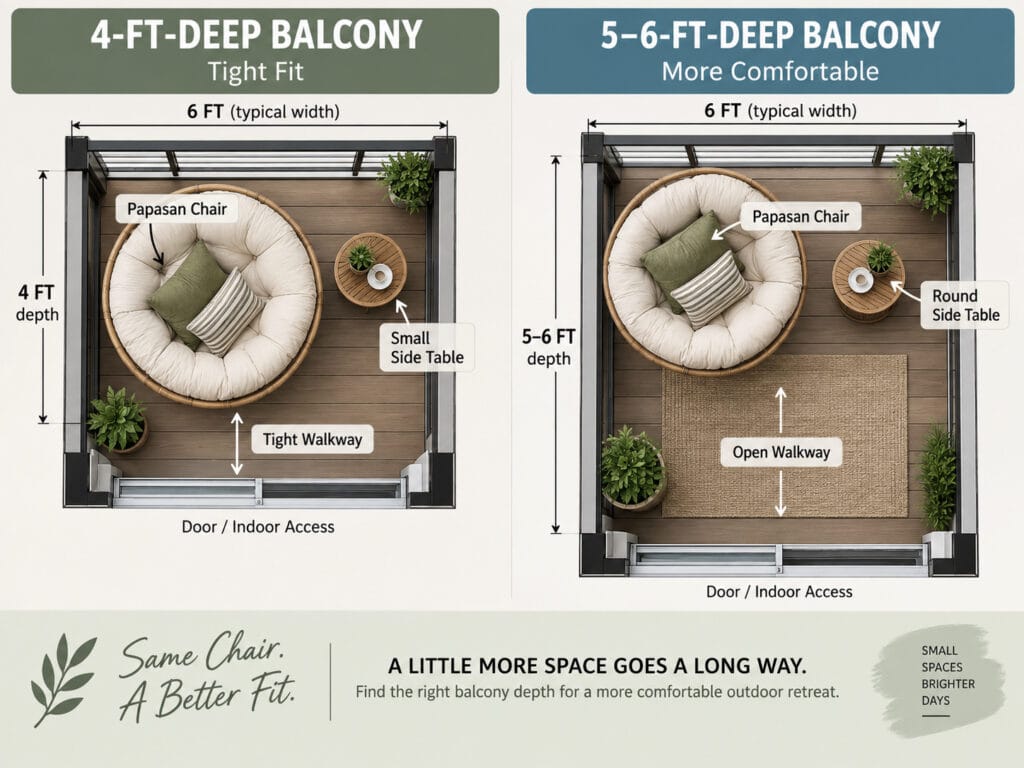
On a 4-Foot-Deep Balcony
A 4-foot-deep balcony gives you only about 48 inches of depth.
If a papasan chair is 36–40 inches deep, it can consume most of that dimension.
It may technically fit, but technical fit is not the same as comfortable use.
For a very narrow balcony:
- choose a smaller overall chair depth;
- skip an oversized coffee table;
- keep the door area open;
- preserve one clear route through the space.
If the layout still feels tight, a compact bistro chair may be more practical than a deep papasan.
For more small-space options, see our small balcony furniture ideas guide.
On a 5–6 Foot-Deep Balcony
A 5–6 foot depth gives you much more flexibility.
You may be able to fit:
- one papasan chair;
- one small side table;
- one planter;
- and a clear walking route.
This is often enough to create a comfortable corner without making the chair dominate the entire balcony.
Three Small Patio Papasan Layout Ideas
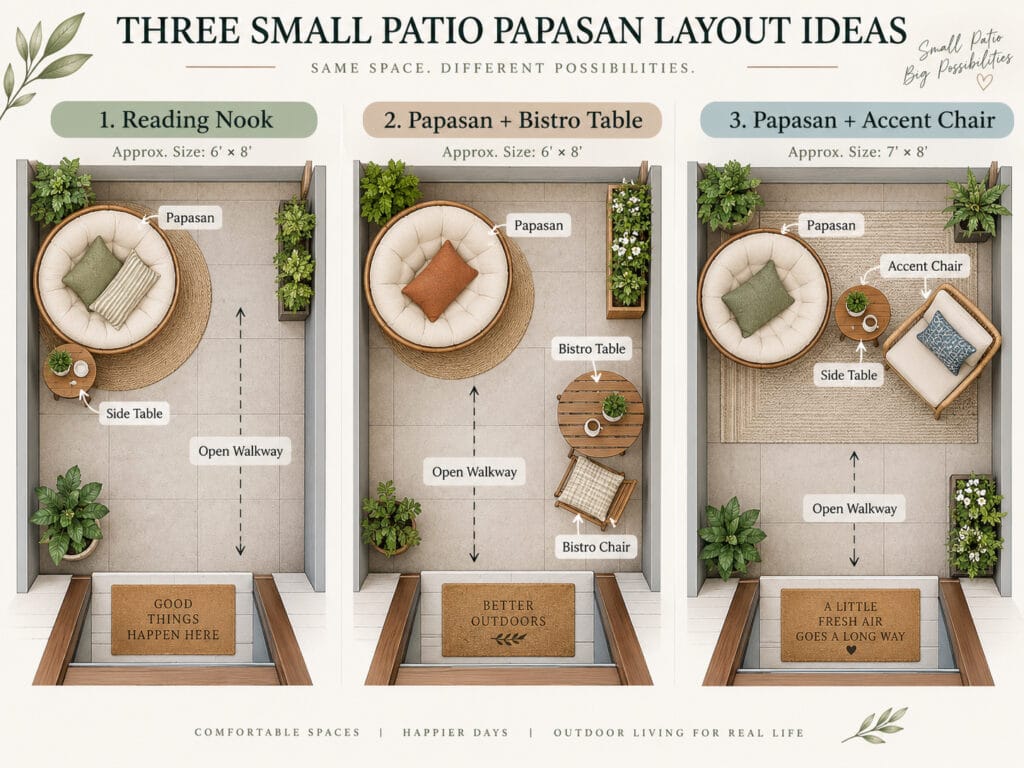
Layout 1: A Papasan Reading Nook
This is one of the most natural ways to use a papasan.
Use the chair as the anchor and add only what the activity needs.
A simple setup:
- papasan chair in the corner;
- 16–20 inch round side table;
- small outdoor rug;
- lantern or solar light;
- one planter.
Why it works:
The chair becomes the focal point, while visible floor space keeps the area from feeling cluttered.
This is especially useful on apartment patios where a full sofa would be too large.
The biggest mistake is adding too many accessories around the chair.
A reading nook usually feels more comfortable when there is still open floor around it.
Layout 2: Papasan + Small Bistro Table
A papasan can share a patio with a small bistro table, but the two pieces should not compete for the same floor area.
A practical arrangement is:
- papasan in one corner;
- 28–30 inch bistro table on the opposite side;
- one compact dining or folding chair;
- clear walkway between the two zones.
This gives the patio two uses:
lounging + light dining
without trying to build two full furniture arrangements.
If the patio is very small, replace the bistro table with a side table.
Layout 3: Papasan + One Accent Chair
For a two-person conversation area, pair the papasan with one smaller chair rather than another oversized lounge chair.
Try:
- one papasan;
- one slim outdoor accent chair;
- one 18–22 inch round side table.
Angle the chairs slightly toward each other.
Do not force perfect symmetry if it blocks the walkway.
On a small patio, a slightly asymmetrical arrangement often works better than a perfectly balanced one.
How Big Should the Side Table Be?
A papasan usually works better with a small side table than with a large coffee table.
For compact layouts, roughly 16–22 inches wide or in diameter is a useful starting point.
The ideal height depends on the chair.
Papasan seats often sit lower than dining chairs, so a very tall table can feel awkward.
Choose a table that can be reached comfortably while seated without leaning far forward.
Why Round Tables Work Well
A small round side table has two advantages:
- it complements the curved shape of the papasan;
- it avoids sharp corners in a tight walkway.
It is also easy to move when you want more swivel clearance.
Keep the Main Walkway Clear
Before placing furniture, identify the route used most often:
house → patio → railing / yard / steps
Protect that route first.
For everyday planning, a path around 30–36 inches wide often feels much easier to use when space allows.
As an accessibility reference, the 2010 ADA Standards specify a 36-inch minimum clear width for walking surfaces that are part of an accessible route where those standards apply. That does not mean every private residential patio is legally required to maintain a 36-inch walkway, but it is a useful reference for understanding why wider circulation paths are easier to use. ADA.gov
This matters even more if you regularly:
- carry food outside;
- have pets;
- use the patio door frequently;
- move cushions indoors;
- or bring plants in seasonally.
For more general furniture-fit planning, see our small patio furniture size guide.
Papasan Chair vs. Loveseat for a Small Patio
Both can work in compact outdoor spaces, but they solve different problems.
| Papasan Chair | Loveseat | |
|---|---|---|
| Seating | 1 person | Usually 2 people |
| Shape | Rounded / curved | Rectangular |
| Best use | Solo lounging | Two-person seating |
| Best placement | Corner or nook | Along a wall |
| Space strategy | Creates one focal seat | Maximizes seat count |
| Swivel option | Common on some models | Rare |
Choose a papasan when:
- one comfortable seat matters more than capacity;
- you want a reading or lounge nook;
- a sofa would visually dominate the patio.
Choose a loveseat when:
- two permanent seats are more important;
- you regularly sit outside with another person;
- the patio has a clear wall for linear furniture.
Papasan Chair vs. Egg Chair
Papasan and egg chairs are often considered for the same kinds of patios, but their footprints and visual effects are different.
A papasan usually has:
- an open bowl-shaped seat;
- a lower visual profile;
- easier side access;
- optional swivel movement.
A hanging egg chair usually has:
- a taller frame;
- a stand or hanging structure;
- a more enclosed seat;
- greater visual height.
For a compact balcony, the papasan may feel visually lighter.
For someone who prefers a more enclosed, cocoon-like seat, an egg chair may be more appealing.
The deciding factor should still be the actual footprint and clearance, not the furniture name.
Common Outdoor Papasan Placement Mistakes
Pushing the Chair Directly Against a Wall
The base may fit, but the upper bowl can still hit the wall when the chair turns.
Leave clearance for the widest moving part.
Blocking the Patio Door
A chair is not well placed if everyone has to squeeze around it to enter or leave the patio.
Protect the main route first.
Using an Oversized Coffee Table
A papasan usually needs only a small side table.
A large center table can make a one-chair layout feel unnecessarily crowded.
Ignoring the Swivel Footprint
A swivel chair can use more functional space than its static product photo suggests.
Test the rotated position.
Filling Every Remaining Corner
If the papasan is already the main lounge seat, you do not need to fill every empty area with furniture or decor.
Visible open floor is part of the layout.
What Material Works Best for an Outdoor Papasan Chair?
For outdoor use, synthetic wicker or PE rattan is generally more practical than natural rattan because it is designed for outdoor conditions.
Look for product-specific details such as:
- PE rattan or resin wicker;
- outdoor-rated metal frame;
- outdoor-use cushion fabric;
- removable cushion or cover where specified;
- stated UV or weather resistance;
- clear care instructions.
Do not assume every chair labeled “rattan” is intended for long-term outdoor exposure.
Natural rattan generally needs more protection from prolonged moisture and direct weather than synthetic wicker.
For a deeper material comparison, see What Is PE Rattan? PE vs. Natural Rattan for Outdoor Furniture.
How to Style a Papasan Without Making the Patio Feel Smaller
Small outdoor spaces usually benefit from restraint.
Instead of surrounding the chair with several accessories, start with:
- one papasan;
- one small round table;
- one planter;
- optional outdoor rug.
Then stop and look at the remaining floor space.
Open-frame tables, raised bases, and smaller planters often feel lighter than large boxy pieces placed around the chair.
The goal is not to fill the patio.
The goal is to make the chair feel intentional while keeping the space easy to move through.
Before You Buy: A Simple Papasan Fit Test
Before ordering, run this quick test:
- Measure the patio or balcony.
- Mark the chair’s full width and depth with painter’s tape.
- Add the side-table footprint.
- Mark the main walking route.
- Open the patio door.
- Simulate swivel movement if the chair rotates.
- Stand inside the taped area and test how you would sit down, stand up, and reach the table.
If the layout already feels crowded when there is only tape on the floor, the actual furniture will usually feel even larger.
This simple test is more useful than judging scale from a staged product image.
Final Recommendation
An outdoor papasan chair can be a strong choice for a small patio, balcony, or covered porch when you want one comfortable lounge seat without committing to a full sofa or conversation set.
The most successful layouts usually have three things in common:
- the chair sits near an edge or corner rather than in the center;
- the main walking route stays clear;
- surrounding furniture stays small and simple.
For a swivel papasan, leave enough room for the seat to rotate and check the full outside dimensions before ordering.
If your goal is a compact reading nook, coffee corner, or one-person lounge area, a papasan can make more sense than a larger patio set.
Looking for a swivel seat for a compact outdoor space? Explore our outdoor wicker papasan chair for exact dimensions, cushion details, available colors, and product specifications.
Frequently Asked Questions About Outdoor Papasan Chairs
How much space do you need for a papasan chair?
Plan around the chair’s full outside width and depth rather than the base alone. Many outdoor papasan chairs fall roughly within the 36–45 inch width range, but exact dimensions vary by model. Swivel designs also need additional room around the moving sides.
Can a papasan chair fit on a balcony?
Yes. Papasan chairs can work well on balconies when placed near one end or in a corner without blocking the door or main walkway. On very narrow balconies, check chair depth carefully before ordering.
How much clearance does a swivel papasan chair need?
There is no single universal clearance because swivel geometry varies by chair. Leave several inches around the moving sides, then test the chair through the angles you expect to use so the bowl does not hit a wall, railing, planter, or table.
What size side table works next to a papasan chair?
A small side table around 16–22 inches wide or in diameter is a useful starting point for compact layouts. Round tables are particularly easy to place beside a curved papasan chair.
Is a papasan chair good for a small patio?
Yes, especially when you want one comfortable reading or lounge seat rather than maximum seating capacity. The key is choosing a chair whose full footprint leaves enough room for access and everyday movement.