An outdoor wicker rocking chair can technically fit on a porch and still feel awkward to use.
The reason is simple: the chair itself is only part of the space you need.
Unlike a stationary patio chair, a rocker moves forward and backward during normal use. You also need room to walk past it, open the front door, reach a side table, and avoid hitting a wall, railing, column, planter, or nearby furniture.
So the better question is not:
“Will this rocking chair fit on my porch?”
It is:
“Will there still be enough usable space around the chair once it starts rocking?”
This guide explains how to plan for the chair footprint, rocking clearance, porch depth, walking paths, side-table spacing, and layouts for one or two outdoor wicker rocking chairs.
Table of Contents
Quick Answer: How Much Space Does an Outdoor Rocking Chair Need?
Start with four separate space requirements:
- Static footprint — the width and depth of the chair while it is sitting still.
- Rocking zone — the extra area used as the chair moves forward and backward.
- Walking clearance — room to pass the chair without stepping into its movement path.
- Side clearance — space for a table, second chair, railing, or porch column.
Outdoor rocking chairs vary by design, but manufacturer guidance from POLYWOOD places many models around 26–30 inches wide and 32–37 inches deep, with heights around 37–45 inches. Deeper lounge-style rockers may extend beyond that range. POLYWOOD
A useful planning summary is:
| Planning factor | Practical starting point |
|---|---|
| Typical rocker width | 26–30 in |
| Typical rocker depth | 32–37 in |
| Deeper lounge rocker | About 38–40+ in |
| Initial rear tape-test zone | About 12–18 in |
| Accessible-route benchmark | 36 in clear width |
| Compact side table | About 16–22 in |
These are planning references, not universal product requirements. Always use the actual dimensions and movement of the chair you are considering.
Typical Outdoor Wicker Rocking Chair Dimensions
Rocking-chair dimensions vary more than standard dining-chair dimensions because the overall footprint depends on several things:
- seat width and depth;
- backrest angle;
- rocker-base length and curve;
- armrest width;
- cushion thickness;
- whether the back extends beyond the base.
A compact porch rocker may be around:
- 27–30 inches wide
- 32–36 inches deep
- 35–40 inches high
A deeper lounge-style rocker can reach roughly 38–40 inches deep.
A real retail example helps show why the full dimensions matter. One current outdoor wicker rocker sold by Target is listed at about 29.5 inches wide × 38.5 inches deep × 35.75 inches high.
The important point is that a 22-inch seat does not mean the whole chair is only 22 inches wide or deep.
Before buying, check the product page for:
- overall width;
- overall depth;
- seat height;
- arm height;
- rocker-base length;
- backrest projection;
- cushion thickness.
For a small porch, overall depth is often the dimension that matters most.
Why the Listed Chair Footprint Is Not Enough
A normal patio chair mostly stays inside its listed footprint.
A rocking chair does not.
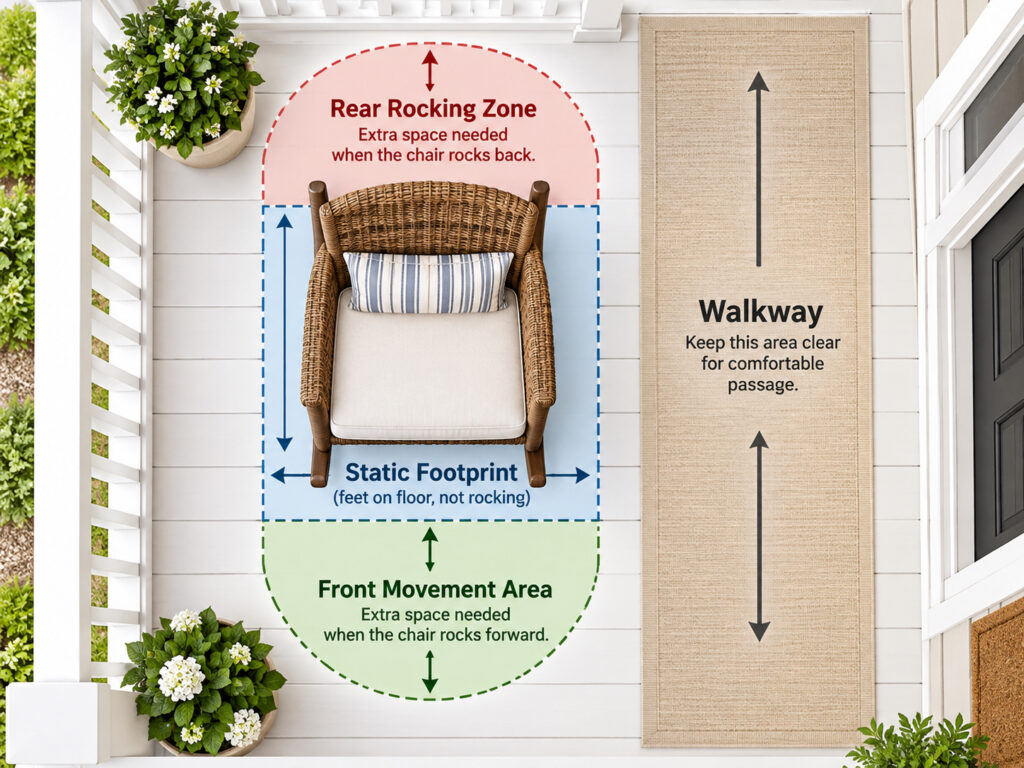
As you lean backward and rock forward again, the chair moves through a small arc. The backrest may travel closer to the wall, while the rocker base can move farther into the walkway.
That means you should think about two different zones:
Static Footprint
The floor area occupied when the chair is sitting still.
Rocking Zone
The additional space the chair uses while moving.
The second zone is the one homeowners are most likely to forget.
A chair that fits neatly against a wall in a product photo may not work well there once someone actually sits down and rocks.
If you are furnishing more than just one chair, our Small Patio Furniture Size Guide explains how to think about furniture footprints, walkways, and usable floor space together.
How Much Rocking Clearance Should You Leave?
There is no single clearance number that works for every rocking chair.
The rocking arc depends on:
- runner shape;
- chair depth;
- seat angle;
- user weight and posture;
- how aggressively the chair rocks.
For a tight porch, adding about 12–18 inches behind the listed chair footprint can be a useful first tape-test.
But that should not be treated as a guaranteed clearance requirement.
POLYWOOD uses a more generous recommendation: it suggests leaving about 2–3 feet of open space around rocking chairs and gliders to allow movement and reduce the chance of bumping into walls or furniture.
That is a good reminder that there is a difference between:
- minimum space that might work, and
- space that feels comfortable in daily use.
The safest method is still to test the actual product dimensions.
How Far Should a Rocking Chair Be From a Wall or Railing?
The chair should sit far enough from the wall that the backrest and rocker base do not touch surrounding structures during normal use.
The correct distance depends on the chair.
A compact, upright rocker may need less room than a deep lounge rocker.
Avoid placing the chair directly against:
- exterior siding;
- porch railings;
- windows;
- columns;
- planters;
- storage boxes.
On a narrow porch, it can help to angle the chair slightly so the rocking motion moves toward the more open part of the porch rather than straight toward a wall or railing.
How Deep Should a Porch Be for a Rocking Chair?
For rocking chairs, porch depth is often more important than total porch width.
A porch can be 12 feet wide and still feel cramped if it is only 4 feet deep.
A deeper porch gives you room for three separate zones:
- the chair footprint;
- the rocking zone;
- the walking path.
A practical way to think about porch depth is:
| Porch depth | Practical fit |
|---|---|
| Around 4 ft | Usually very tight for a conventional rocker if the area also serves as a walkway |
| Around 5 ft | Possible with a compact rocker and no main path directly in front |
| Around 6 ft | More workable for many standard outdoor rockers |
| 7–8 ft+ | Much more flexible for a rocker, side table, second chair, or wider walkway |
These are layout ranges, not building-code minimums.
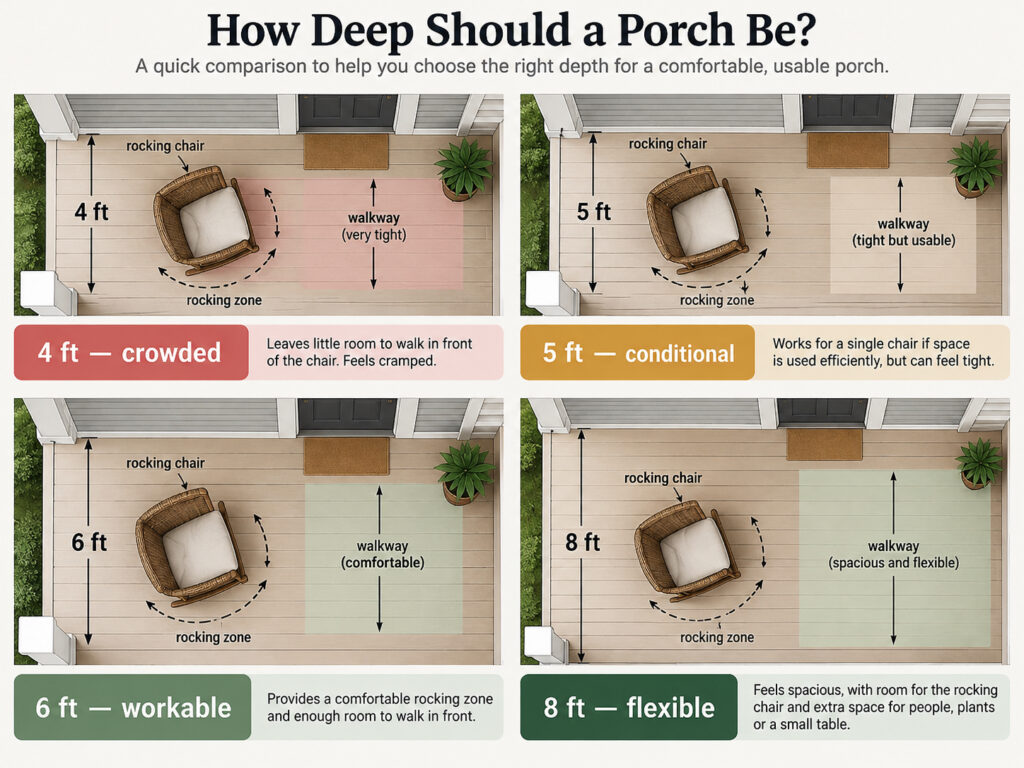
Around 4 Feet Deep
A standard rocker may physically fit, but it can consume most of the usable depth.
If the front door or main walking route is directly in front of the chair, this layout usually becomes uncomfortable very quickly.
Around 5 Feet Deep
A compact rocker may work, especially if:
- the chair sits at one end of the porch;
- the main walkway runs beside it instead of in front;
- there is no storm door opening into the seating area.
A large lounge rocker will usually feel much more difficult here.
Around 6 Feet Deep
This is much easier to work with.
You have more flexibility to give the chair room to move while still keeping some usable circulation space.
Around 7–8 Feet or More
Now you can usually start thinking about:
- two rockers;
- a shared side table;
- a more generous walkway;
- a small secondary furniture piece.
Keep the Front Door and Main Walking Path Clear
One of the most common layout mistakes is measuring the empty floor but forgetting the door.
Before placing a rocker, check:
- which direction the front door swings;
- whether you have a storm door or screen door;
- where guests naturally walk;
- where packages are usually left;
- whether furniture blocks the normal entry path.
For code context, the International Residential Code uses a 32-inch minimum clear width for the required egress door in one- and two-family dwellings. ADA accessibility standards use 36 inches minimum clear width for accessible walking surfaces in many applications. ADA.gov
Those numbers should not be treated as universal rocking-chair spacing rules for every private porch.
They are useful reference points because they reinforce a practical principle:
Do not let furniture consume the space your door and normal entry route need to function.
If you want to preserve an accessible-style path through the porch, 36 inches of clear width is a useful planning benchmark.
One Rocking Chair vs. Two Rocking Chairs
A single rocker is much easier to place.
You only need to manage one chair footprint and one rocking zone.
Two chairs introduce a new question:
Can both chairs move comfortably without hitting each other or the table between them?
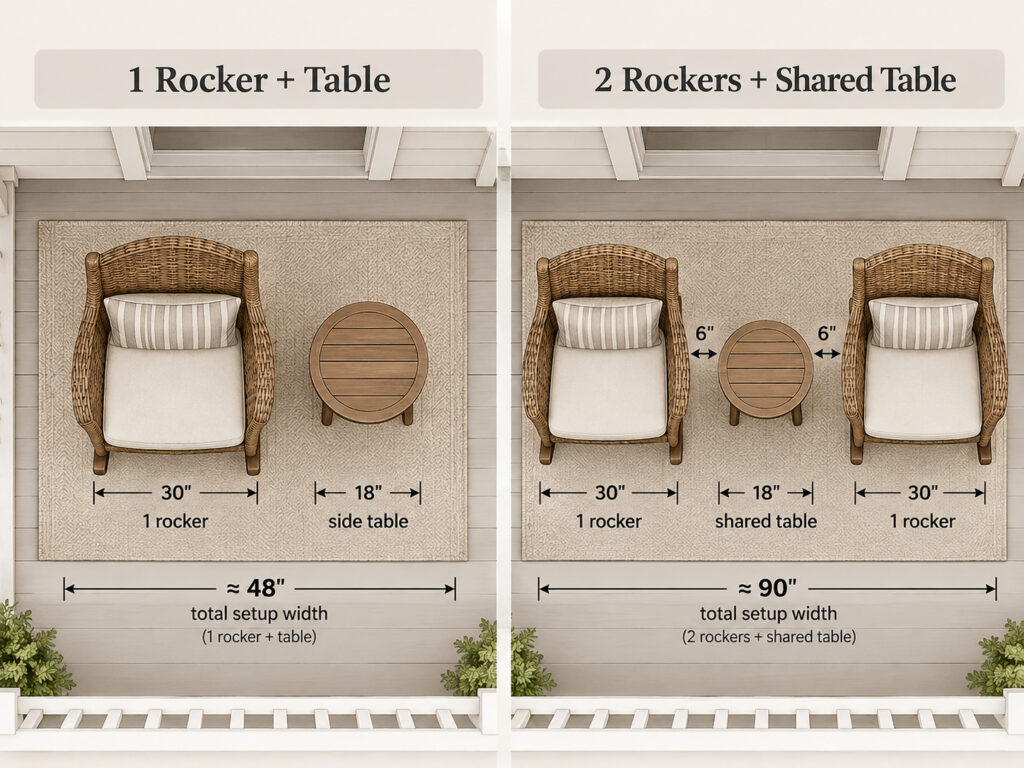
For two rockers, calculate:
- chair width × 2;
- spacing between chairs;
- side-table width, if used;
- rear rocking clearance;
- walking room around the group.
For example:
Two 30-inch-wide rockers already occupy about 60 inches of total chair width.
Add an 18–22 inch side table and a little breathing room on both sides of the table, and the entire seating group can easily approach or exceed 7 feet in width.
That is why simply saying:
“My porch is 8 feet wide”
does not tell you whether two rockers will fit comfortably.
You have to account for the whole arrangement.
How Much Space Should Be Between Two Rocking Chairs?
For a relaxed porch layout, 18–24 inches between chair edges is a practical starting range when there is no table in between.
That gives room for:
- sitting down and standing up;
- arm movement;
- a small object on the floor;
- easier cleaning.
If a table sits between the chairs, use the table width to determine the spacing.
Do not push the chairs tightly against the table.
The rocker base and armrests both need room to move.
What Size Side Table Works Beside a Rocking Chair?
A compact side table in roughly the 16–22 inch range often works well beside a porch rocker.
The ideal position is:
- beside the armrest;
- slightly forward of the chair center;
- outside the rocker’s movement path.
The goal is simple:
The table should be easy to reach without becoming something the chair can hit.
On a narrow porch, two chairs sharing one side table is usually more space-efficient than giving each rocker its own table.
Four Practical Front-Porch Rocking Chair Layouts
There is no single best layout, but four arrangements work especially well for common U.S. porch shapes.
1. One Rocker at the End of the Porch
Best for:
- narrow porches;
- small entry porches;
- long but shallow front porches.
Place the chair toward one end rather than in the middle of the circulation path.
Keep the rocking direction pointed toward open space.
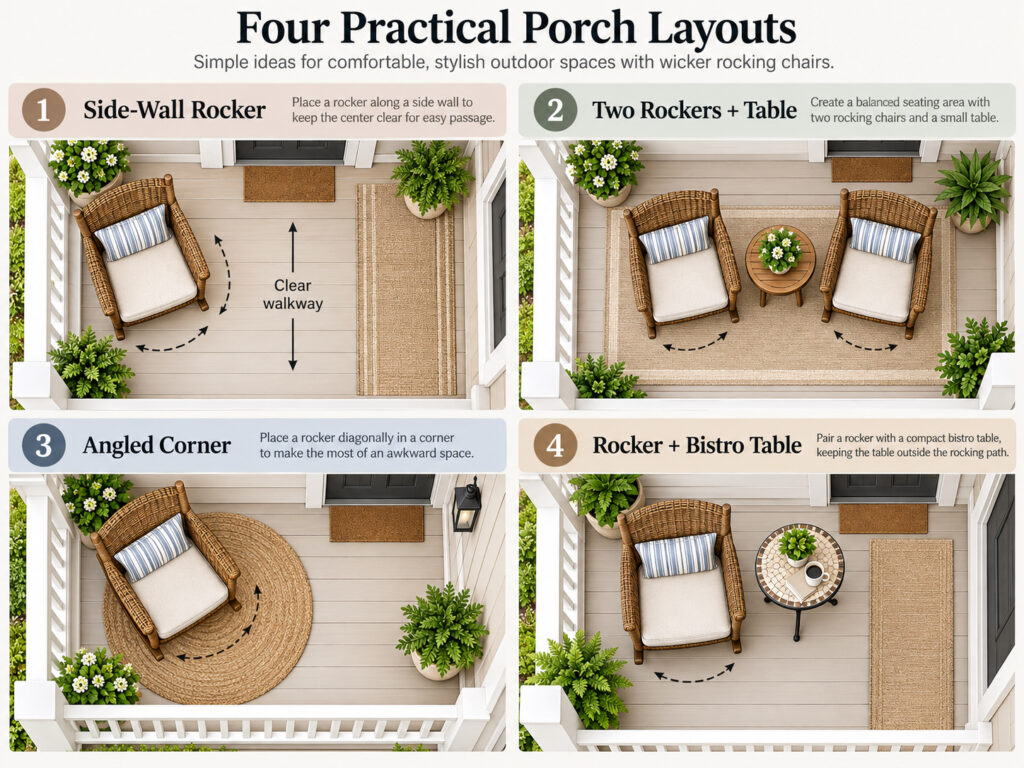
2. Two Rockers With a Shared Side Table
This is the classic front-porch arrangement.
Place a small table between the chairs and make sure both rockers have enough rear clearance.
It works best when the seating area can sit beside the main walkway rather than across it.
3. Angled Corner Rocker
Useful when:
- a column is nearby;
- the porch is irregularly shaped;
- a railing makes parallel placement awkward.
Turning the chair slightly can redirect the rocking motion toward a more open area.
4. Rocker + Small Bistro Table
This works best on a deeper porch.
Keep the table to the side of the rocker rather than directly in front of the movement path.
A small table can make the space more useful for coffee or breakfast without turning the rocker into a dining chair.
Covered Porch vs. Open Patio Placement
The amount of space a rocker needs does not change much between a covered porch and an open patio.
What changes is the weather exposure.
Covered Porch
A covered porch usually reduces:
- direct rain;
- intense sun;
- repeated wet-dry cycles.
That can make it easier to use cushioned wicker furniture in everyday seating areas.
Open Patio
On an uncovered patio, pay more attention to:
- cushion drying time;
- drainage;
- direct UV exposure;
- rain exposure;
- covers or storage.
Do not assume every product labeled “wicker” has the same outdoor performance.
Synthetic PE rattan and natural rattan are very different materials. If you are comparing outdoor suitability, see our PE Rattan vs. Natural Rattan guide.
For any specific rocker, check the product page for the exact:
- frame material;
- wicker type;
- cushion fabric;
- care instructions;
- weather-resistance claims.
A Simple 3-Step Painter’s Tape Fit Test
This is one of the most reliable ways to check a porch before ordering.
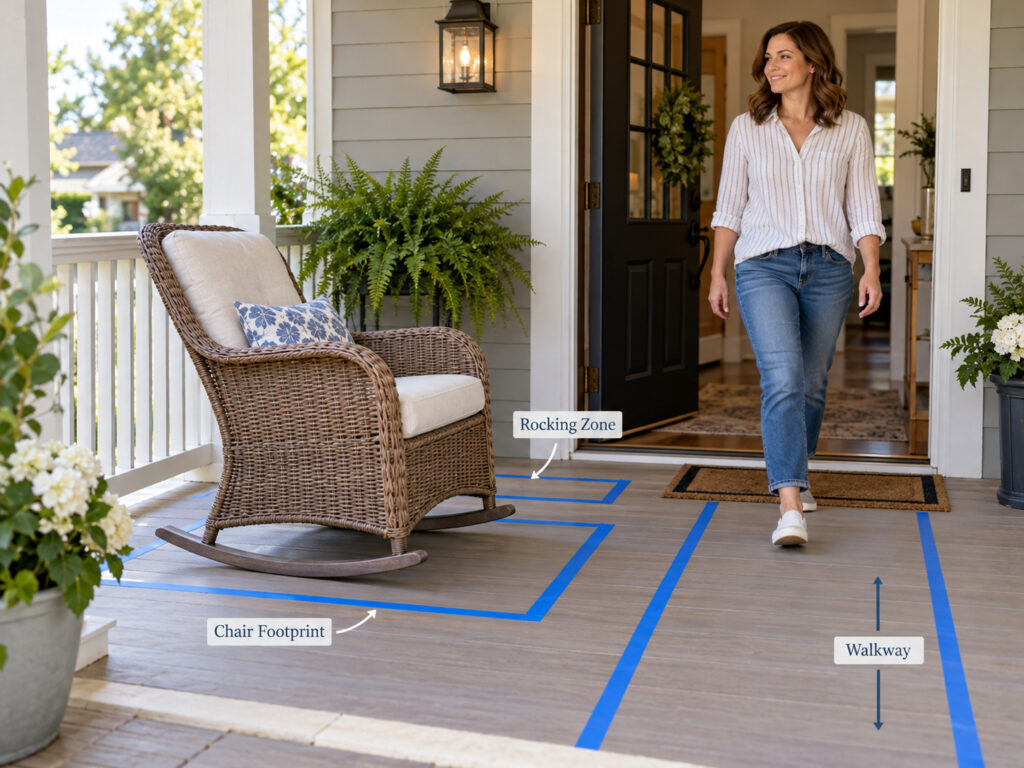
Step 1: Tape the Static Footprint
Use painter’s tape to mark the chair’s full listed width and depth on the porch floor.
Do not use only the seat dimensions.
Use the overall product dimensions.
Step 2: Add a Rocking Zone
Extend the tape behind the chair footprint.
For an initial test, you can add roughly 12–18 inches behind the chair.
Then look at the actual chair geometry and adjust if needed.
If the manufacturer provides a recommended clearance, use that instead.
Step 3: Walk the Real Route
Now use the porch the way you normally would.
- Open the front door.
- Carry a package inside.
- Walk past the taped chair.
- Pretend you are carrying a cup of coffee.
- Mark the outline of a side table.
- Add a second rocker if you plan to buy one.
If you have to turn sideways just to get past the tape, the real chair will not make the porch feel larger.
Common Rocking-Chair Placement Mistakes
Measuring Only the Seat
Seat width is not overall chair width.
Armrests and rocker bases can add several inches.
Ignoring the Rocking Motion
A 36-inch-deep chair needs more than 36 inches of usable depth if it is actually going to rock.
Blocking the Main Walkway
Keep a clear route to the front door.
Putting the Chair Too Close to the Wall
The backrest can hit the siding as the chair rocks.
Placing the Side Table in the Rocking Path
Keep the table beside the chair, not inside the front-to-back movement zone.
Buying Two Chairs Before Testing One
On a small porch, measure and tape one chair first.
If one rocker already dominates the space, adding a second will not fix the layout.
What Size Rocking Chair Works Best for a Small Porch?
For a compact porch, look for a chair with:
- narrower overall width;
- shallower overall depth;
- a more upright back;
- less front-to-back rocker-base projection;
- moderate rather than oversized cushions.
A large lounge rocker may be very comfortable but can easily overwhelm a 5-foot-deep porch.
In very tight spaces, a stationary outdoor chair or compact bistro chair may be a better fit than a traditional rocker.
The goal should not be to choose the smallest chair possible.
It should be to choose the smallest chair that still feels comfortable and can move normally without blocking the space around it.
Final Recommendation
Start with the exact product dimensions, but do not stop there.
A usable outdoor wicker rocking chair setup needs:
- the static chair footprint;
- room for the rocking motion;
- distance from walls, railings, and columns;
- a clear route to the front door;
- side space for a table or second chair.
For most homeowners, the simplest way to avoid a poor fit is to tape the chair footprint onto the porch before buying.
Then add a realistic rocking zone and walk through the space normally.
If the door still opens freely, the walkway still feels comfortable, and the chair has room to move without hitting anything, the layout is much more likely to work in everyday use.
If you are comparing a specific model, check its listed overall width and depth against your taped layout before ordering.

Frequently Asked Questions
How much clearance does a rocking chair need behind it?
There is no universal number because rocker designs vary. For an initial home test, about 12–18 inches behind the listed footprint can be useful, but some chairs need more. Manufacturer guidance should take priority.
Can a rocking chair fit on a 5-foot-deep porch?
Sometimes. A compact rocker may fit if the main walking path does not run directly in front of it. Deeper lounge-style rockers are much harder to use comfortably on a 5-foot-deep porch.
How far apart should two porch rocking chairs be?
Roughly 18–24 inches between chair edges is a practical starting point when no table sits between them. If there is a table, base the spacing on the table width plus a little extra room around it.
What size side table works beside a rocking chair?
A compact side table around 16–22 inches wide often works well, as long as it stays outside the chair’s rocking path.
Are wicker rocking chairs good for covered porches?
Many outdoor wicker rockers work well on covered porches, but materials vary. Check the exact wicker, frame, cushion fabric, and care instructions for the model you are considering.