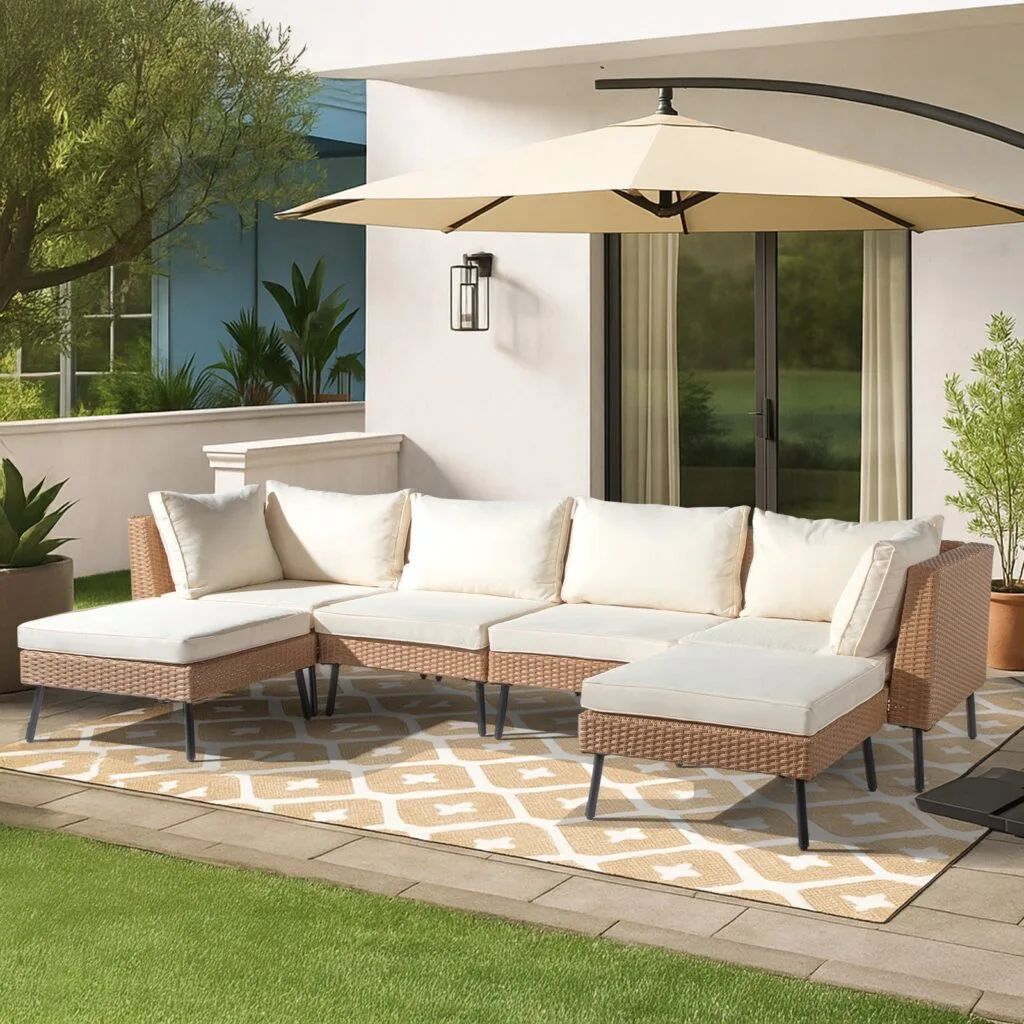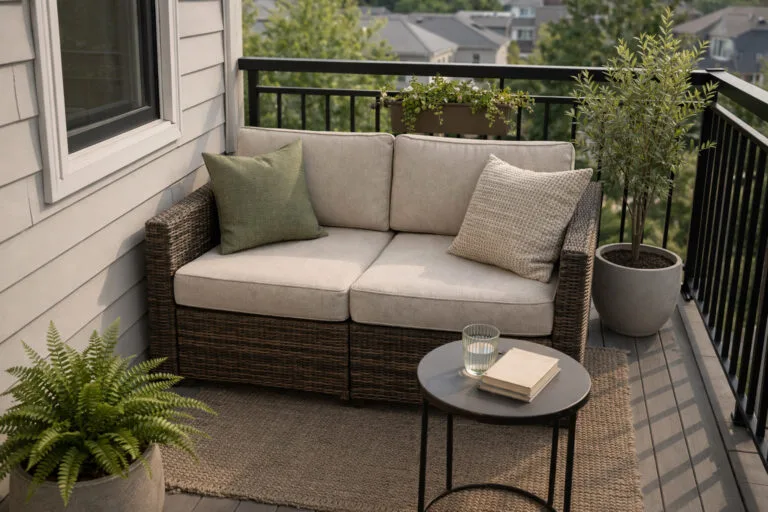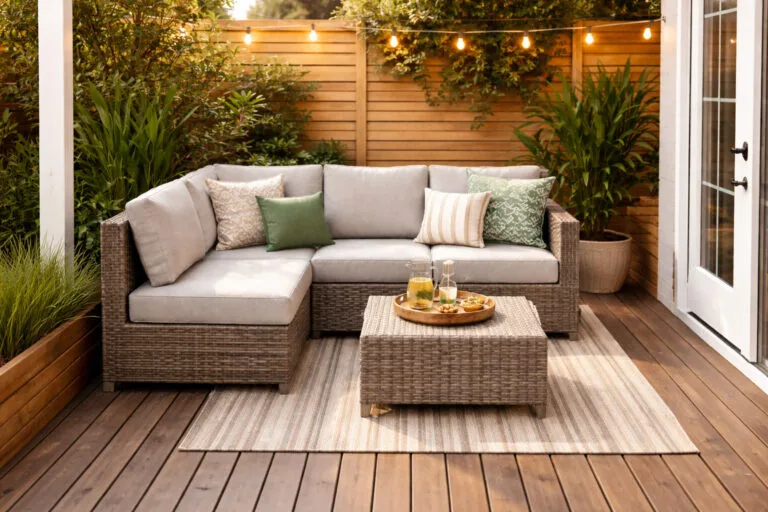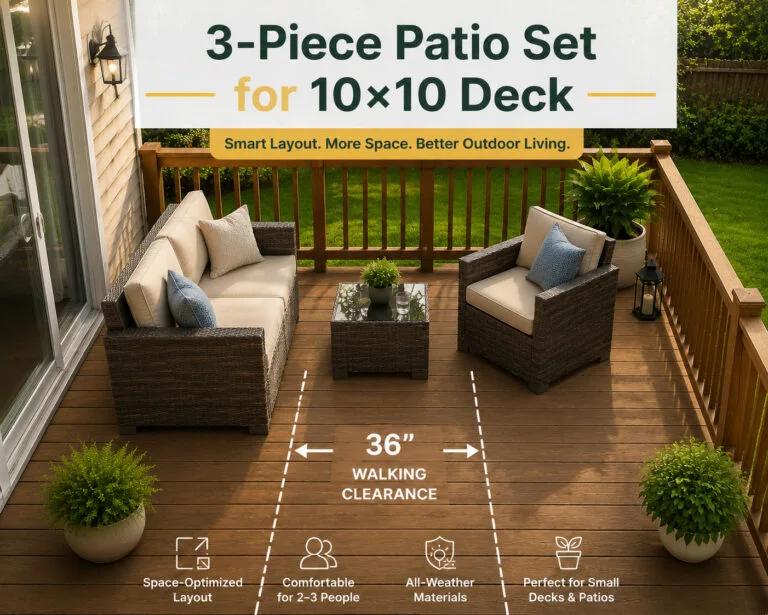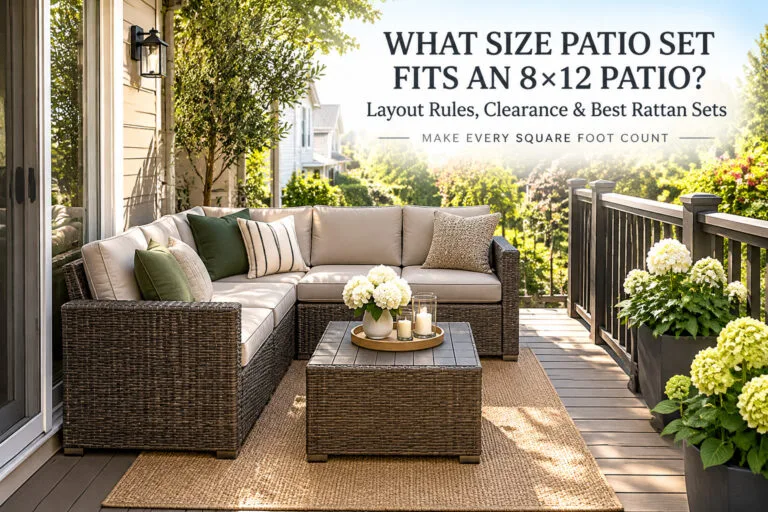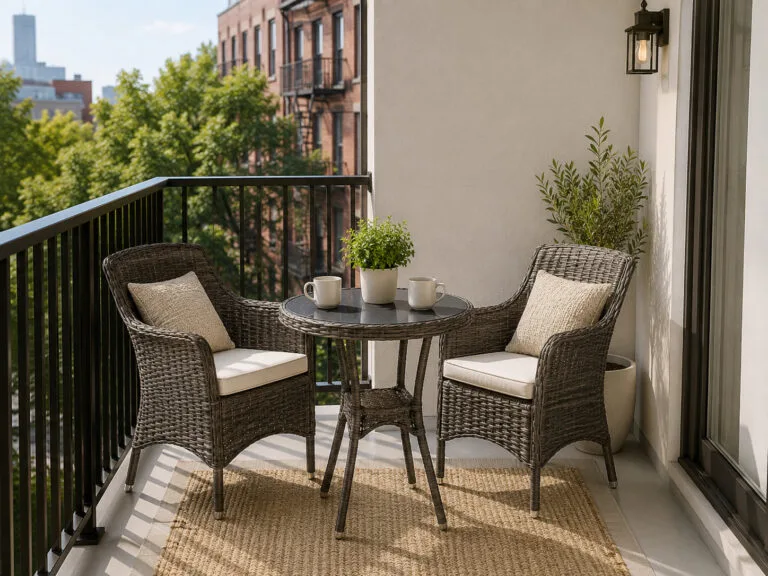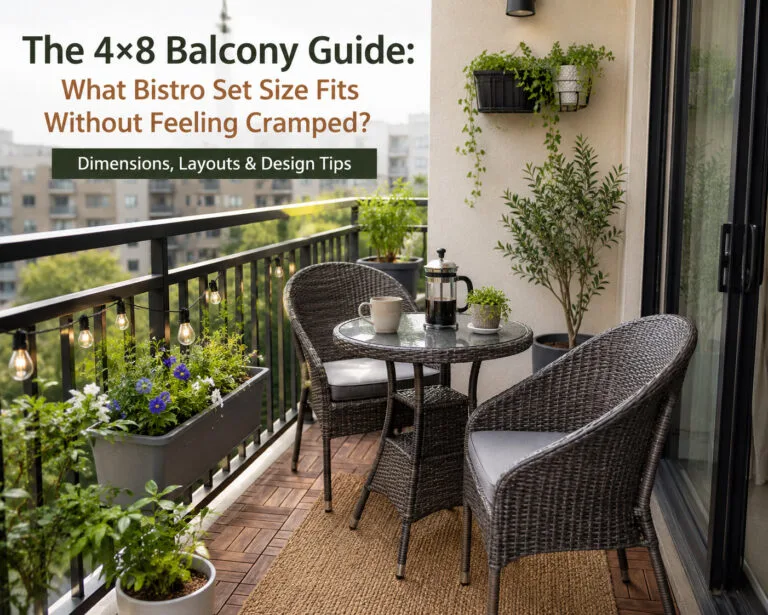
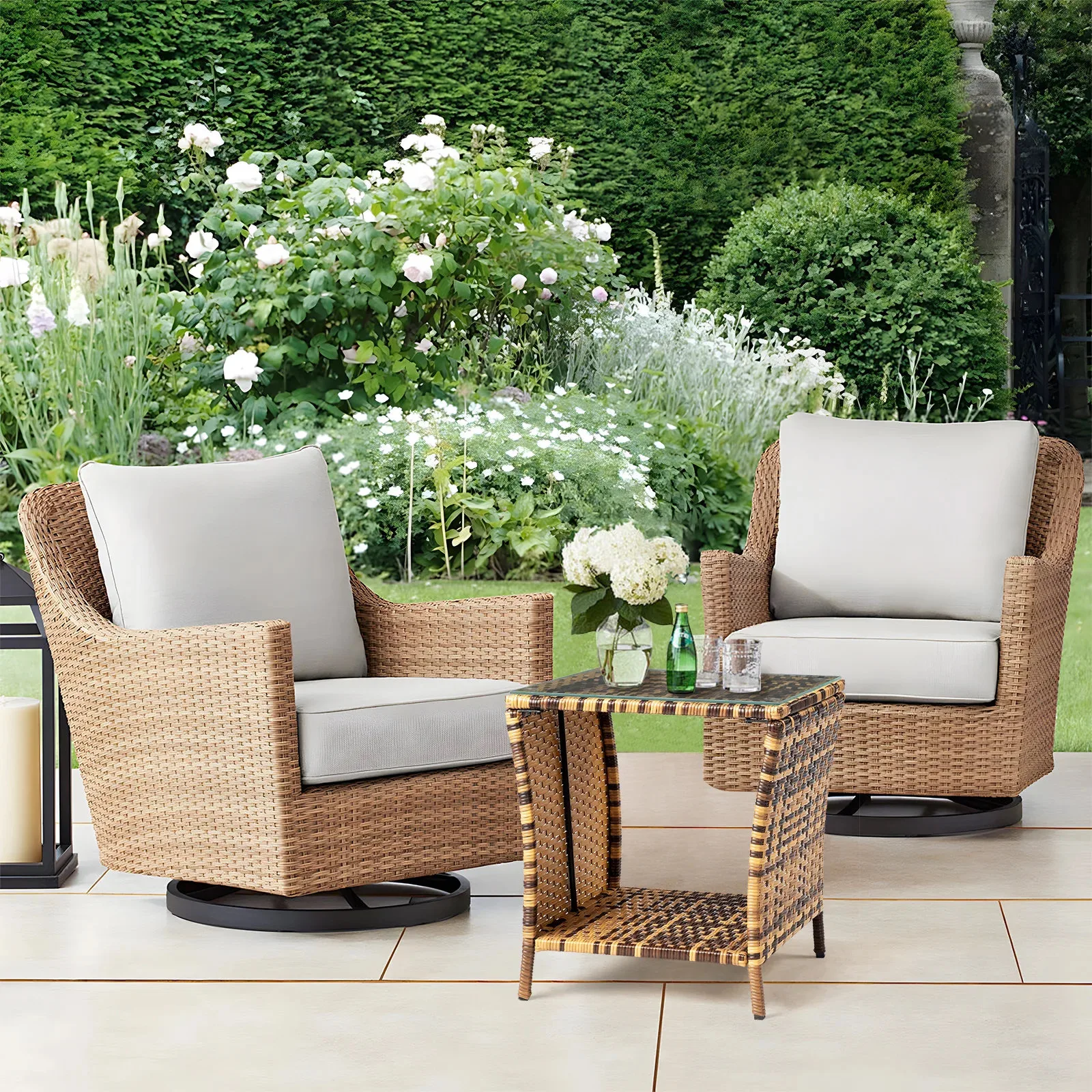
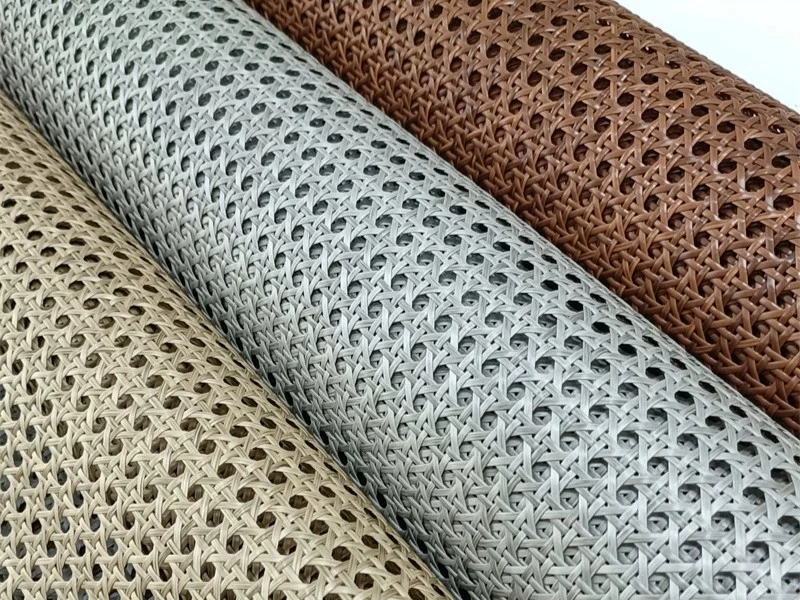
PE rattan is a synthetic weaving material made from polyethylene. In the U.S., it is also commonly sold as resin wicker, synthetic wicker, or all-weather wicker.
Unlike natural rattan, which comes from climbing palm plants, PE rattan is manufactured for outdoor furniture and woven around a supporting frame. It is generally better suited to rain, humidity, and regular patio use—but quality varies significantly between products.
Choose PE rattan for uncovered patios, decks, balconies, and poolside areas; choose natural rattan for indoor rooms, sunrooms, and covered patios that stay dry.
Table of Contents
What Is PE Rattan? Understanding the Materials
PE rattan is a synthetic weaving material made primarily from polyethylene, a type of plastic resin. In the United States, similar materials are often marketed as resin wicker, synthetic wicker, or all-weather wicker.
Unlike natural rattan, PE rattan does not come from a plant. It is manufactured in flexible strands and woven around a supporting furniture frame, commonly made from aluminum or powder-coated steel. The word “rattan” is used because the finished weave resembles traditional rattan furniture.
PE rattan is widely used for outdoor chairs, sectionals, dining sets, and bistro sets because it generally handles moisture and routine outdoor exposure better than natural plant fibers. However, quality varies according to the resin formulation, UV protection, weaving, frame construction, and other product details.
What Is Natural Rattan?
Natural rattan comes from the flexible stems of climbing palm plants that grow in tropical regions. After harvesting, the stems are dried, processed, and woven into furniture.
Natural rattan is valued for its organic texture, natural color variation, lightweight construction, and handcrafted appearance. However, it can absorb moisture and may swell, develop mildew, fade, or become brittle after repeated exposure to rain and strong sunlight. It is generally best suited to indoor rooms, sunrooms, and covered patios that remain relatively dry.
What Is PE Rattan Made Of?
PE rattan strands are manufactured from polyethylene resin. During production, the material can be colored, textured, and formed into flat, half-round, or round strands before being woven around a furniture frame. This allows manufacturers to create consistent colors, weave patterns, and furniture styles.
PE rattan is only one part of an outdoor furniture set. The frame, fasteners, cushions, fabric, drainage, and overall construction can be just as important as the wicker strands. A water-resistant weave does not automatically make the complete furniture set waterproof.
Is PE Rattan the Same as Resin Wicker?
In outdoor furniture descriptions, PE rattan and PE resin wicker often refer to the same polyethylene weaving material. However, “wicker” technically describes a weaving method rather than a specific material.
Wicker furniture can be made from natural rattan, willow, bamboo, polyethylene, polypropylene, PVC, or other materials. A product described only as “wicker” is therefore not necessarily made from PE rattan.
When comparing furniture, check the material specification instead of relying only on terms such as “wicker” or “all-weather.” Our guide to the difference between rattan and wicker explains these terms in more detail.
What Is HDPE Wicker?
HDPE stands for high-density polyethylene, one form of polyethylene used to manufacture some synthetic wicker strands.
HDPE wicker may be used in well-made outdoor furniture, but the label alone does not guarantee better durability. Outdoor performance also depends on UV stabilizers, pigments, strand thickness, weaving quality, frame construction, climate, maintenance, and warranty coverage.
Review the complete product specifications instead of judging a patio set by the “HDPE” label alone. The next section compares PE rattan and natural rattan directly.
PE Rattan vs Natural Rattan: Key Differences
PE rattan and natural rattan can create a similar woven appearance, but they are fundamentally different materials. PE rattan is manufactured from polyethylene resin, while natural rattan comes from climbing palm fibers.
The best choice depends on the furniture’s location, weather exposure, maintenance requirements, and the type of appearance you prefer.
| Factor | PE Rattan | Natural Rattan |
|---|---|---|
| Source | Manufactured from polyethylene resin | Made from natural climbing palm fibers |
| Common U.S. term | Often sold as PE resin wicker or synthetic wicker | Usually sold as natural rattan |
| Best location | Outdoor patios, decks, balconies, and poolside areas | Indoor rooms, sunrooms, and covered patios |
| Rain resistance | Generally handles moisture well, although the complete set may not be waterproof | Absorbs moisture and needs protection from repeated rain |
| Sun resistance | Better suited to sunlight when made with UV-stabilized resin | Can fade, dry, or become brittle after prolonged exposure |
| Maintenance | Usually needs routine cleaning and occasional inspection | Requires more careful moisture control and protected storage |
| Appearance | Consistent colors, textures, and weave patterns | Organic texture with natural color and fiber variations |
| Repairability | Damaged synthetic strands can be difficult to match and replace | May be repaired or rewoven by a skilled furniture restorer |
| Lifespan | Depends on resin quality, frame construction, climate, exposure, and care | Can last for years when kept dry and properly protected |
| Best for | Buyers who prioritize outdoor practicality and lower maintenance | Buyers who value natural materials and handcrafted character |
The table compares the weaving materials themselves. The performance of a complete furniture set also depends on its frame, fasteners, cushions, fabric, drainage, UV protection, and overall construction.
Quick Decision
Choose PE rattan if:
- The furniture will remain on an uncovered patio, deck, or balcony
- Rain, humidity, or strong sunlight are regular concerns
- You prefer lower maintenance and a consistent finish
Choose natural rattan if:
- The furniture will be used indoors or under reliable cover
- You prefer authentic plant fibers and natural variation
- You can keep the furniture dry and protected
Neither material is universally “better.” PE rattan is normally better for regular outdoor exposure, while natural rattan is better when authentic plant fibers and handcrafted texture are the priority.
The next section examines how both materials respond to rain, sunlight, humidity, and changing temperatures.
Durability and Weather Resistance
Outdoor furniture durability depends on more than the visible wicker. Resin strands, frames, fasteners, cushions, drainage, climate, and storage all affect how a furniture set performs over time.
PE rattan generally handles outdoor exposure better than natural rattan, but not every synthetic wicker set is waterproof, fade-proof, or maintenance-free.
Rain and Moisture
PE rattan strands do not absorb water like natural plant fibers, making them more suitable for patios exposed to occasional rain and humidity. The weave is less likely to swell, and surface water can usually be wiped away.
However, water-resistant wicker does not make the complete furniture set waterproof. Other components may be more vulnerable:
- Scratched or poorly coated steel frames may rust
- Screws, brackets, and other fasteners may corrode
- Water may collect inside hollow frames
- Cushion foam may retain water if it cannot drain
- Damp dirt and debris may support surface mildew
For wet or humid locations, look for a powder-coated aluminum frame, corrosion-resistant hardware, drainage openings, outdoor fabric, and cushions designed to release moisture. Allow cushions and furniture to dry before covering or storing them.
For more detail, see Is PE Rattan Waterproof?.
Sun and UV Exposure
Natural rattan may fade, dry, or become brittle after prolonged exposure to strong sunlight. PE rattan is generally better suited to outdoor UV exposure, but fade resistance still varies between products.
Important factors include:
- UV stabilizers in the resin
- Polyethylene quality and pigments
- Strand thickness and profile
- Furniture color
- Daily sun intensity and duration
Dark-colored wicker can become warm in direct sunlight. Lighter colors, cushions, umbrellas, pergolas, and partial shade can improve comfort and reduce unnecessary UV exposure.
Look for specific information about UV stabilization, fade resistance, care instructions, and warranty exclusions. General descriptions such as “all-weather wicker” do not explain how a product will perform after prolonged sun exposure.
See our guide to protecting rattan outdoor furniture from sun damage and fading for additional care guidance.
Best Material by Climate
Use these recommendations as a starting point while also considering the frame, cushions, hardware, and available storage.
| Climate or Location | Best Starting Point | What to Check |
|---|---|---|
| Florida and the Gulf Coast | PE rattan with an aluminum frame | Cushion drainage, airflow, removable covers, hardware, and mildew cleaning |
| Arizona and Texas | UV-stabilized PE rattan | Fade warranty, resin details, lighter colors, shade, and extreme-heat care |
| Pacific Northwest and rainy regions | PE rattan with quick-drying components | Frame drainage, cushion drying, covered storage, and ventilation |
| Coastal areas | PE rattan over powder-coated aluminum | Frame coating, welds, screws, salt buildup, and coastal-use guidance |
| Cold or freezing climates | Quality PE rattan that can be protected or stored | Winter storage, trapped water, cover ventilation, and handling when extremely cold |
| Covered patios and sunrooms | PE or natural rattan | Rain exposure, humidity, sunlight, maintenance, and preferred appearance |
| Indoor rooms | Natural rattan | Stable humidity, routine cleaning, and protection from prolonged direct sunlight |
For most uncovered patios, PE rattan is the more practical starting point. Natural rattan is usually better for indoor and protected spaces where authentic plant fibers and handcrafted texture matter more than weather resistance.
How to Identify Good-Quality PE Rattan Furniture
The phrase “PE rattan” does not describe the quality of an entire furniture set. Two products may use similar polyethylene wicker but perform differently because of their resin, UV protection, weaving, frame, cushions, hardware, and warranty.
Before buying, look beyond the color and product photos. The following five checks can help distinguish a well-specified outdoor set from furniture that relies mainly on terms such as “all-weather wicker.”
1. Check the Resin Specification
Start by checking whether the product clearly identifies the weaving material. Look for:
- PE or polyethylene
- HDPE or high-density polyethylene
- Another specifically identified synthetic resin
Be cautious when a listing uses only vague descriptions such as “plastic wicker,” “rattan effect,” “synthetic rattan,” or “all-weather material.” These terms do not clearly explain what the strands are made from.
Strand profiles may be flat, half-round, or round. Each can be used successfully, so material consistency and construction matter more than strand shape alone.
2. Look for UV and Fade Information
Outdoor wicker receives regular sunlight, but PE rattan products do not all have the same UV protection. Check for:
- UV-stabilized resin
- Fade-resistance information
- Suitability for prolonged outdoor exposure
- Recommended use of covers or shade
- Warranty exclusions for fading or cracking
Do not treat terms such as “UV-resistant” or “weatherproof” as lifetime guarantees. A specific product specification or written warranty is more useful than a promise that the furniture will “never fade.”
Color also affects outdoor use. Dark wicker may become warmer in direct sunlight, while lighter colors may show dirt more easily.
3. Inspect the Weaving Quality
A consistent weave helps distribute weight, maintain the furniture’s shape, and reduce stress on individual strands. Check for:
- Even spacing between strands
- Consistent tension across seats, backs, and arms
- Smooth, neatly finished corners
- Securely finished strand ends
- No exposed sharp tips or unusually loose sections
- Adequate support in weight-bearing seat areas
The weave should feel secure without appearing overstretched. Strands pulled too tightly may experience additional stress around corners, while loose weaving may sag or shift.
Small variations are normal in handwoven furniture. The important question is whether the weave appears stable, balanced, and securely attached to an appropriate support structure.
4. Examine the Frame Construction
PE rattan is woven around a supporting frame, and that frame may fail before the wicker.
Aluminum frames are lightweight and naturally resistant to rust, making them useful in rainy or humid locations. Powder-coated steel frames are generally strong and stable, but scratches or incomplete coating may allow corrosion to begin.
Regardless of the frame material, inspect:
- Welds and connection points
- Bolts, screws, and brackets
- Coating coverage
- Chips, scratches, or exposed metal
- Foot caps and floor protectors
- Drainage openings in hollow sections
Corrosion-resistant hardware is especially important near the coast. A good weave cannot compensate for weak welds, rusting fasteners, or water trapped inside the frame.
5. Review the Cushions and Warranty
Cushions are often the first part of an outdoor set to retain moisture or require replacement. Look for:
- Removable, zippered cushion covers
- Fabric intended for outdoor use
- Foam or filling that can release moisture
- Ties or nonslip backing
- Replacement covers or cushions
Water-repellent fabric is not necessarily waterproof. Water may still enter through seams or zippers, so cushions should be allowed to dry fully before being covered or stored.
Also check whether the warranty addresses:
- Wicker cracking or splitting
- Frame, weld, or hardware defects
- Significant fading
- Rust or corrosion
- Cushion coverage and replacement parts
Read the exclusions carefully. Some warranties may not cover normal fading, coastal exposure, severe weather, commercial use, or damage caused by improper storage.
A Practical Pre-Purchase Checklist
Before ordering a PE rattan set, confirm that:
- The material clearly states PE or HDPE
- UV or fade information is available
- Weave tension appears consistent
- Corners have no exposed strand ends
- The frame material is disclosed
- Cushion covers are removable
- Replacement cushions are available
- Warranty terms are specific
If these details are missing, request the product specifications before buying. Clear information about materials, construction, and warranty coverage is more useful than broad labels such as “premium,” “all-weather,” or “maintenance-free.”
Design and Comfort
PE rattan can be manufactured in different colors, textures, and strand profiles, allowing it to create styles ranging from contemporary sectionals to traditional woven chairs.
The wicker affects appearance and surface feel, but seat dimensions, backrest angle, cushion construction, and support beneath the weave usually have a greater effect on comfort.
Flat, Half-Round, and Round Wicker Strands
PE rattan is commonly available in three strand profiles:
| Strand Profile | Typical Appearance | Common Design Use |
|---|---|---|
| Flat wicker | Smooth, streamlined, and relatively uniform | Modern furniture, compact patio sets, and lightweight designs |
| Half-round wicker | More dimensional than flat wicker without the full depth of round strands | Sectionals and dining sets that balance appearance and weight |
| Round wicker | Fuller, more textured, and closer to traditional natural rattan | Classic chairs, substantial sectionals, and traditional designs |
Strand shape influences appearance but does not determine quality. A well-made flat weave may perform better than a poorly constructed round weave.
Weaving Density and Support
Weaving density affects both appearance and support. A good weave should have consistent spacing, balanced tension, secure strand ends, smooth corners, and suitable support beneath seating areas.
Loose weaving may shift or sag, while strands pulled too tightly may experience additional stress around corners. The supporting frame should carry most of the furniture load rather than relying on the visible wicker alone.
What Actually Determines Comfort?
Comfort depends more on the complete seat design than on the wicker material. Important factors include seat depth, seat height, backrest angle, cushion thickness, foam support, and the structure beneath the seat.
Deep, reclined seating generally suits lounging, while shallower and more upright seating works better for dining. Compare the furniture dimensions with its intended use instead of judging comfort from cushion thickness alone.
Temperature and Sunlight
PE rattan can become warm in direct sunlight, especially in dark brown, black, or charcoal finishes. Cushions may also heat up depending on their fabric and color.
For patios with strong afternoon sun, consider lighter colors, removable cushions, and shade from an umbrella or pergola.
PE rattan is used for bistro sets, chairs, loveseats, sectionals, dining sets, and other outdoor furniture. A two-seat rattan bistro set may suit a compact balcony, while modular outdoor rattan sectionals provide flexible seating for larger patios.
Maintenance, Safety, and Environmental Considerations
PE rattan generally requires less moisture control than natural rattan, but it is not maintenance-free. Routine cleaning, cushion care, frame inspection, and appropriate storage can help extend the usable life of the furniture.
Safety and environmental impact also depend on the complete product—not only the visible wicker.
Maintenance
Gentle, regular cleaning is usually more effective than allowing dirt, pollen, food residue, or damp debris to collect in the weave.
Basic maintenance includes:
- Brush or vacuum away loose debris
- Wash with mild soap and water
- Avoid close-range pressure washing
- Inspect loose strands and scratches in the frame coating
- Allow cushions to dry completely
- Cover or store the set during extended periods of non-use
Avoid abrasive pads, stiff wire brushes, strong solvents, and harsh cleaners unless the manufacturer specifically recommends them. Before covering or storing the furniture, make sure the wicker, frame, and cushions are dry.
For complete cleaning instructions, see How to Clean and Protect Outdoor Wicker Furniture.
Safety
PE rattan is made primarily from polyethylene, but the safety of a finished furniture product cannot be determined from the words “PE rattan” alone. Resin formulation, pigments, UV stabilizers, other additives, coatings, adhesives, cushion materials, manufacturing controls, and product testing can all affect the finished set.
For that reason, do not assume that every PE rattan product is automatically “non-toxic” or “chemical-free.” Look for a clear material specification, manufacturer information, intended-use instructions, weight capacity, applicable testing information, and product recall or warranty details. Also inspect the furniture for sharp strand ends, unstable frames, loose fasteners, and damaged welds.
For a fuller discussion, see Is PE Rattan Toxic?.
Environmental Considerations
PE rattan should not automatically be described as environmentally friendly or 100% recyclable. Polyethylene may be accepted by some recycling programs, but availability varies, and wicker strands may contain pigments, stabilizers, or other additives.
Complete furniture is harder to recycle because it commonly combines PE wicker, metal frames, hardware, coatings, fabric, foam, plastic components, and sometimes glass or wood. These materials may need to be separated, and many recycling programs do not accept complete patio furniture.
A more useful environmental assessment considers:
- How long the furniture remains usable
- Whether hardware or damaged parts can be repaired
- Whether replacement cushions and covers are available
- Whether the product can be reused, resold, donated, or recycled in parts
Natural rattan is plant-based, but its environmental performance also depends on sourcing, harvesting, processing, finishes, transportation, repairability, and product lifespan. It may last for many years when used in a suitable indoor or protected environment.
Neither material is automatically the better environmental choice. A well-constructed product that suits its intended location, remains in use for years, and allows cushions or hardware to be replaced is generally more meaningful than a broad “eco-friendly” or “recyclable” label.
What We Recommend: Choosing the Right Rattan for Your Space
The right choice depends less on which material is “best” in general and more on where the furniture will be placed, how much weather exposure it will receive, and how much maintenance you are willing to provide.
Choose PE Rattan If:
- Your patio, deck, or balcony is not completely covered
- Rain, humidity, or direct sunlight are regular concerns
- The furniture will remain outdoors for much of the season
- You prefer easier cleaning and lower routine maintenance
- You want consistent colors and modern outdoor styles
PE rattan is usually the more practical starting point for exposed spaces. If furniture weight matters, look for an aluminum frame; steel frames and large modular pieces may be considerably heavier.
Choose Natural Rattan If:
- The furniture will primarily be used indoors
- It will be placed in a sunroom or enclosed porch
- The patio is reliably protected from rain
- You prefer natural variation and plant-based fibers
- You are willing to control moisture and provide more careful maintenance
Natural rattan performs best in dry, protected environments. Remember that a roof alone may not prevent wind-driven rain, strong afternoon sunlight, or prolonged humidity.
If Both Materials Could Work
Some covered porches, screened rooms, and indoor-outdoor spaces may be suitable for either material. Ask:
- Can wind-driven rain reach the furniture?
- Does the space remain humid after storms?
- How much direct sunlight reaches the furniture?
- Can the furniture be moved indoors when necessary?
Choose natural rattan when the space remains consistently dry and natural texture is the priority. Choose PE rattan when there is uncertainty about rain, humidity, sunlight, or seasonal storage.
Look Beyond the Wicker
Look beyond the wicker when the furniture will be used near the coast, exposed to intense sunlight, paired with outdoor cushions, built on a steel frame, or sold without clear warranty terms.
Check:
- Frame material and protective coating
- Welds, screws, and corrosion-resistant hardware
- UV information and fade-related warranty terms
- Cushion drainage, removable covers, and replacement availability
- Care instructions and specific warranty exclusions
These details may have a greater effect on furniture lifespan than whether the synthetic weave is described as PE or HDPE.
Our Final Recommendation
Choose PE rattan for uncovered patios, balconies, decks, poolside spaces, and other locations with regular outdoor exposure.
Choose natural rattan for indoor rooms, sunrooms, enclosed porches, and reliably covered spaces where natural texture and craftsmanship are the main priorities.
In either case, evaluate the complete furniture set—not only the visible weave. If PE rattan is the better match for your space, browse our PE rattan outdoor furniture sets to compare seating capacity, dimensions, frame construction, and patio layouts.
Frequently Asked Questions About PE Rattan
What Is PE Rattan Made Of?
PE rattan is made primarily from polyethylene resin. Manufacturers form the resin into flexible flat, half-round, or round strands and weave them around a supporting furniture frame. It may also be called PE resin wicker or synthetic wicker, but it is not made from natural rattan plants.
How Long Does PE Rattan Last Outdoors?
PE rattan has no universal outdoor lifespan. Its durability depends on resin quality, UV protection, weaving, frame material, climate, storage, and care. A well-constructed set may remain usable for several years, although cushions, fasteners, or steel frames may need attention before the wicker itself fails.
Is PE Rattan Truly Waterproof?
PE rattan strands are generally water-resistant, but the complete furniture set is not necessarily waterproof. Frames, screws, cushions, seams, and foam may retain water or corrode. Aluminum frames, corrosion-resistant hardware, drainage openings, and quick-drying cushions are generally better suited to wet or humid conditions.
Is PE Rattan Safe and Environmentally Friendly?
The PE label alone does not confirm the safety or environmental impact of every product. Finished-product safety depends on the resin formulation, additives, pigments, coatings, and manufacturing controls. Polyethylene may be recyclable where accepted, but complete furniture is more difficult to recycle because its wicker, frame, hardware, and cushions must often be separated.
What Is HDPE Wicker?
HDPE wicker is synthetic wicker made from high-density polyethylene. HDPE identifies the resin type, but it does not by itself guarantee better UV resistance or durability. Weaving quality, pigments, additives, frame construction, climate, care, and warranty coverage also affect how the finished furniture performs outdoors.