If you are furnishing a small patio, balcony, or compact backyard space in the U.S., the biggest mistake homeowners make is simple:
❌ Choosing furniture based on style before understanding real spatial fit.
A visually appealing outdoor set means nothing if it blocks your door, removes walking space, or makes your patio feel smaller than it actually is.
This guide explains exactly what size patio furniture fits real American outdoor spaces from 5×8 ft to 12×12 ft, based on professional landscape design standards, ADA clearance rules, and real residential layout data.
Table of Contents
Why Patio Size Matters More Than Furniture Style
According to Houzz and Apartment Therapy small-space behavior studies, more than 60% of small patio buyers regret their first furniture purchase due to size mismatch—not design issues.
Common problems include:
- Furniture blocking door swing
- No functional walking path
- Oversized sectional dominating the entire space
- Coffee tables turning into obstacles instead of usable surfaces
Designer Rule (Industry Standard)
Professional U.S. outdoor designers consistently follow one principle:
✔ Patio furniture should occupy no more than 50–60% of usable space
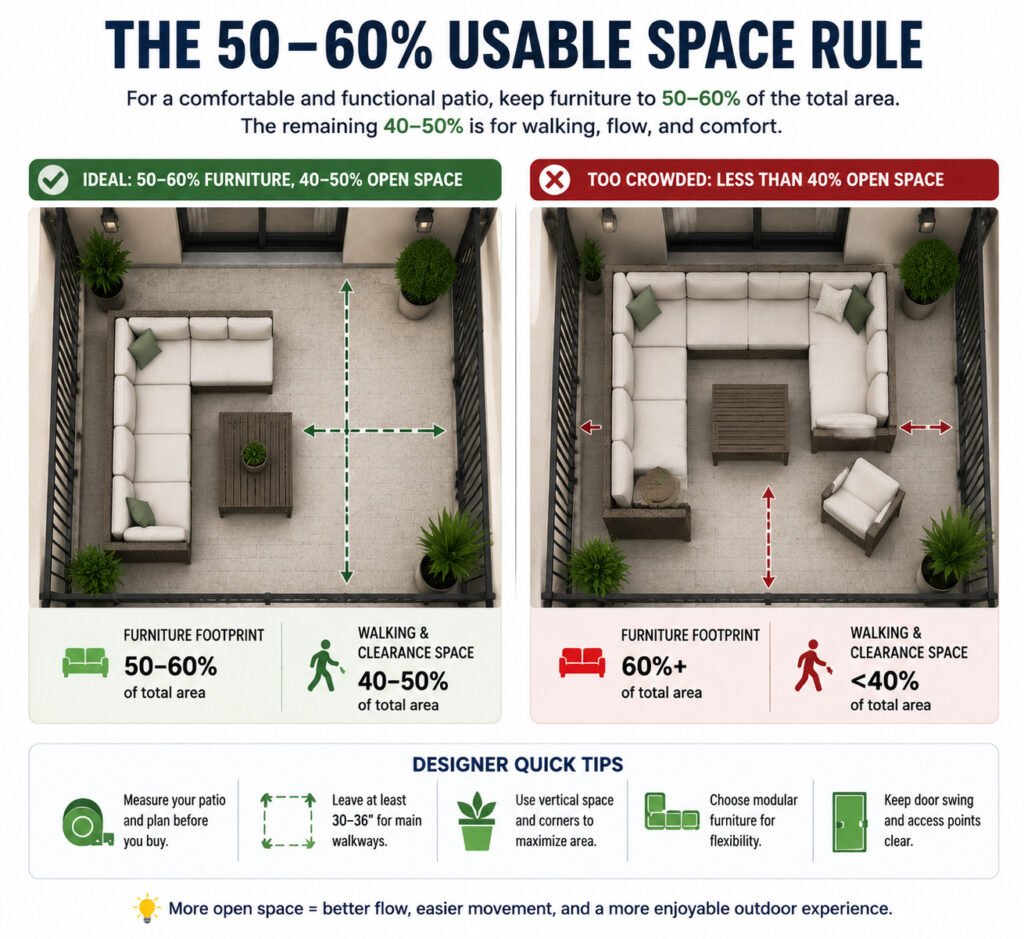
This guideline is widely used in residential landscape planning practices referenced by ASID (American Society of Interior Designers) and reinforced across Houzz, HGTV, and The Spruce outdoor design case studies.
Why this rule matters:
- Maintains safe circulation space
- Preserves door accessibility
- Prevents visual overcrowding
- Allows flexible furniture rearrangement
Once furniture exceeds this threshold, the patio becomes a static space instead of a usable living area.
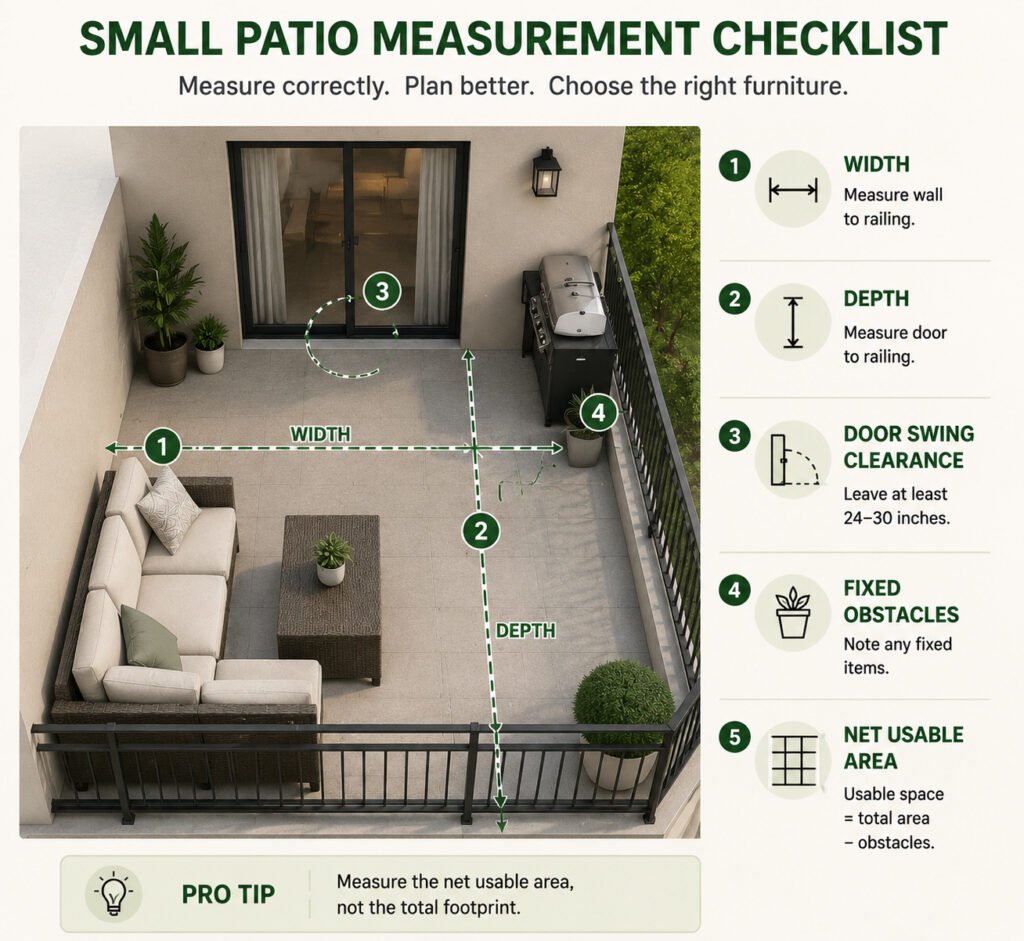
Step 1: Measure Your Patio Correctly (Critical Foundation)
Most homeowners underestimate usable space. Always measure net usable area, not total footprint.
Key measurement framework used by designers:
| Measurement | Design Standard Reference | Why it matters |
|---|---|---|
| Width (wall to railing) | ASLA landscape planning practice | Determines maximum furniture length |
| Depth (door to railing) | IRC residential outdoor layout rules | Controls seating depth |
| Door swing clearance | ADA accessibility standard (24–30 in) | Ensures safe entry/exit |
| Fixed obstacles | HVAC units, posts, lighting | Reduces usable footprint |
| Net usable area | Houzz spatial planning method | Real furniture layout zone |
Critical insight
In real residential patios:
✔ Usable space is typically only 60–75% of total patio area
This is why furniture often feels “too big” even when dimensions appear correct on paper.
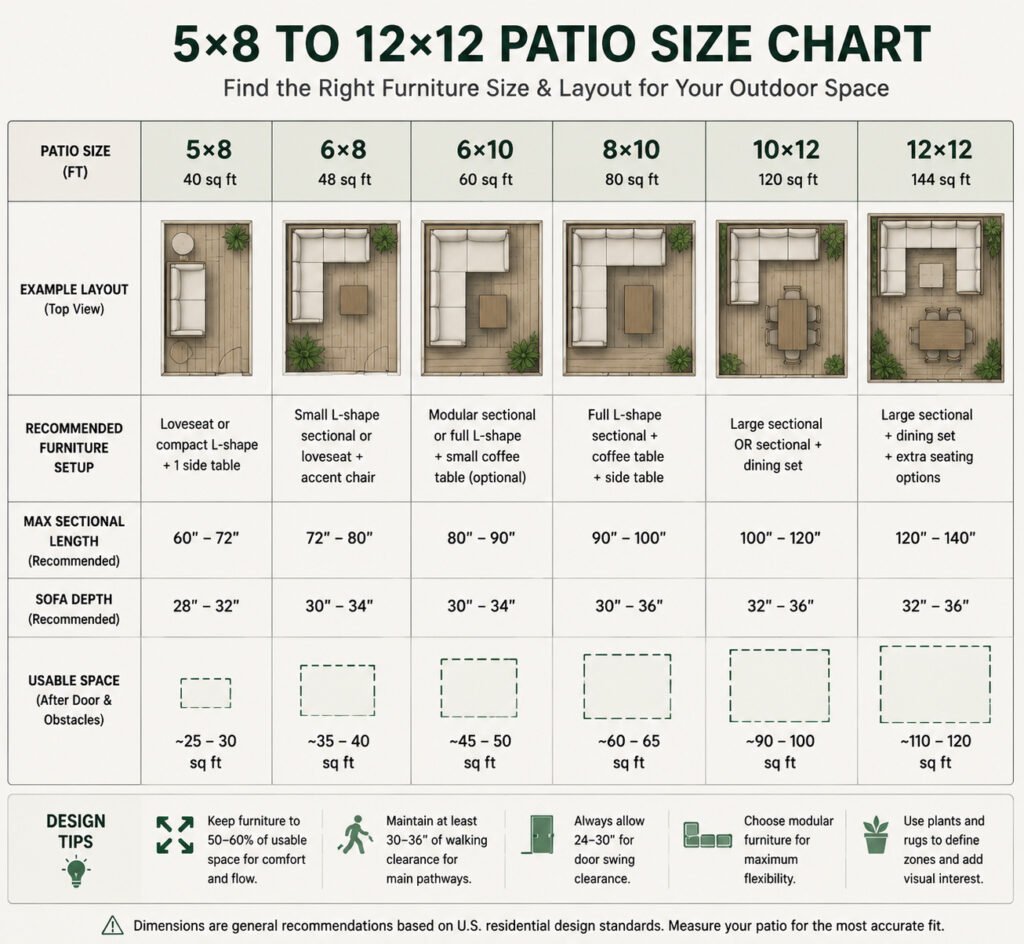
Step 2: Patio Size vs Recommended Furniture Layout
5×8 ft Patio (Ultra Small Space)
- Total area: 40 sq ft
- Usable space: ~25–30 sq ft
Recommended setup:
- Loveseat OR compact L-shaped corner sectional
- 1 small side table (18–20 in max)
Furniture limits:
- Max length: 60–72 in
- Depth: 28–32 in
Layout rule:
Keep at least one full side completely open for movement.
Avoid:
- Coffee tables larger than 20 inches
- Full-size sectional sofas
6×8 ft Patio (Most Common Apartment Balcony)
- Total area: 48 sq ft
- Usable space: ~35–40 sq ft
Recommended setup:
- Modular L-shaped sectional OR loveseat + corner chair
Furniture limits:
- 72–80 in L-shape
- 30–34 in depth
Layout principle:
L-shape should anchor into the corner to maximize central open space.
Design note:
This is the most common balcony size in NYC, Chicago, and San Francisco apartments, and is widely used in modular patio furniture design systems.
6×10 ft Patio (Flexible Small Yard Space)
- Usable space: ~45–50 sq ft
Recommended setup:
- Modular sectional OR full L-shaped sofa
- Optional coffee table (max 24 in)
Furniture limits:
- 80–90 in total length
Layout rule:
Modular flexibility is more important than fixed design at this size.
8×8 Ft Patio (Compact Square Space)
- Usable space: ~45–50 sq ft
Recommended Setup:
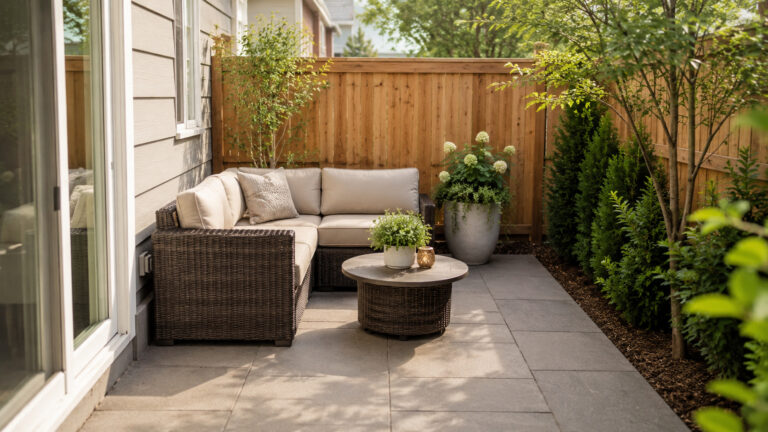
- Compact L-shaped sectional
- Loveseat + 1–2 compact chairs
- Small conversation set or bistro setup
Furniture Limits:
- 70–80 in sectional
- 29–33 in overall depth
Layout Rule:
Keep one side or corner relatively open and prioritize furniture depth in this square layout.
8×10 ft Patio (Small Outdoor Living Room)
- Usable space: ~60–65 sq ft
Recommended setup:
- Full L-shaped sectional
- Optional coffee table + side table
Furniture limits:
- 90–100 in sectional
- 30–36 in depth
Layout outcome:
This size allows a true “outdoor living room” setup.
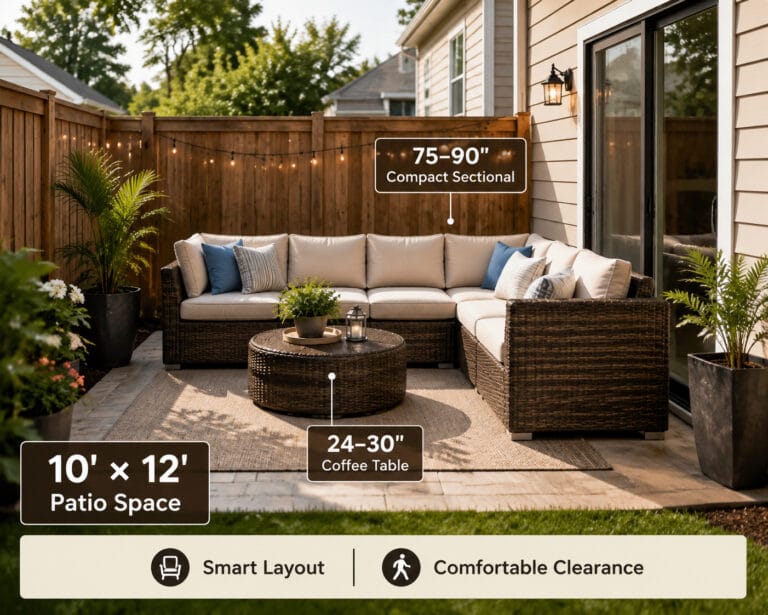
10×12 ft Patio (Entertainment Zone)
- Usable space: ~90–100 sq ft
Recommended setup:
- Large sectional OR sectional + dining combo
Layout rule:
Divide space into seating zone + dining zone if possible.
12×12 ft Patio (Full Outdoor Living Area)
- Usable space: ~110–120 sq ft
Recommended setup:
- Full sectional + dining set
- Multiple seating zones possible
Layout outcome:
Functions as a full extension of indoor living space.
Step 3: Walkway & Clearance Rules (Non-Negotiable)
These standards are based on ADA accessibility guidelines and NFPA safety recommendations.
| Area | Minimum | Recommended | Why it matters |
|---|---|---|---|
| Door swing clearance | 24 in | 30 in | Safe entry/exit |
| Main walkway | 30 in | 36 in | Comfortable movement |
| Furniture spacing | 18 in | 24 in | Prevents crowding |
| Wall clearance | 2 in | 4–6 in | Prevents moisture buildup |
Key principle
Even 2–3 inches of miscalculation can make a patio feel unusable.
Step 4: Best Furniture Types by Patio Size
Small patios (5×8 – 6×8)
- Loveseats
- Compact L-shaped sectionals
- Folding side tables
Medium patios (6×10 – 8×10)
- Modular sectional sofas (BEST option)
- L-shaped sofas + side tables
Large small patios (10×12 – 12×12)
- Full sectional sets
- Dining + seating hybrid layouts
Step 5: Designer Layout Strategies
Layout A — Wall-Aligned L Shape (Best Overall ⭐)
- L-shape placed along wall + railing
- Keeps center open
- Maximizes usability in all sizes
Layout B — Corner Maximization
- Uses corner as anchor point
- Best for 5×8 and 6×8 spaces
Layout C — Modular Split Layout
- Separate seating modules instead of fixed sofa
- Allows seasonal reconfiguration
Common Mistakes (High Impact on Conversions)
❌ Buying based on product images
Most product photos are shot in oversized outdoor spaces, making furniture appear 20–30% smaller than reality.
❌ Ignoring real usable space
Structural elements reduce usable space by up to 40% in some apartments.
❌ Oversized coffee tables
In small patios, coffee tables should stay under:
- 20–24 inches max
❌ Fixed oversized sectional sofas
They permanently reduce flexibility and cannot adapt to seasonal use.
×12 spaces. Includes layout rules, clearance standards, and expert U.S. design guidelines.
Final Takeaway
A small patio is not a limitation—it’s a design optimization problem.
The formula is simple:
✔ Measure correctly → Respect clearance rules → Match furniture to usable space
Follow this system, and even a 40 sq ft patio can feel like a functional outdoor living room.